
Introduction
If you have ever encountered the question, “Which one of the following is a chemical change?” in a science quiz, homework assignment, or multiple-choice examination, the key is to identify whether a substance has changed into a new substance. Chemical changes occur in everyday life, from cooking food to burning wood and the rusting of iron. Understanding these processes makes it easier to recognize the correct answer in science questions.
A chemical change involves a chemical reaction that produces one or more substances with different chemical compositions and properties. Unlike a physical change, which affects a material’s size, shape, or state, a chemical change alters the substances themselves. Learning the difference between these two types of changes can help students answer chemistry questions more confidently.
Which One of the Following Is a Chemical Change?
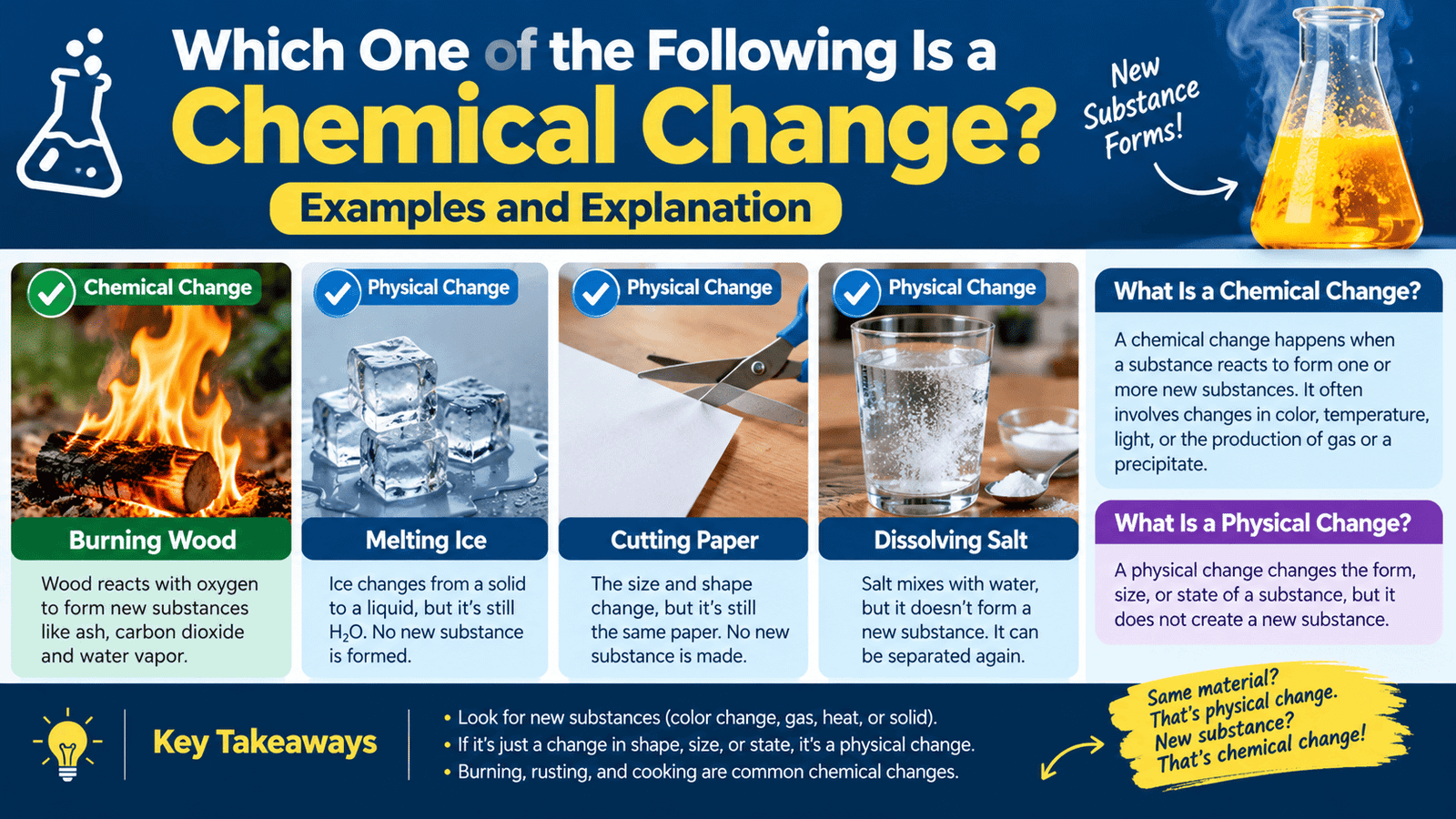
The correct answer depends on the options provided in the question. However, burning wood is a common example of a chemical change because it produces new substances, including ash, gases, and smoke.
Other examples include rusting iron, cooking an egg, baking a cake, and digesting food. In each case, chemical reactions produce substances with different properties from the original materials.
Consider these common multiple-choice options:
- Melting ice
- Cutting paper
- Boiling water
- Burning wood
Correct answer: Burning wood.
Burning wood is a chemical change because combustion produces new substances. The other three examples are generally physical changes because they do not change the chemical identity of the material itself.
What Is a Chemical Change?
A chemical change occurs when one or more substances react and form new substances. During this process, chemical bonds may break, form, or rearrange, changing the composition of the original materials.
For example, when iron reacts with oxygen and moisture, it gradually forms rust. Rust has different chemical properties from the original iron, demonstrating that a chemical reaction has occurred.
Chemical changes can happen quickly, as in the burning of paper, or slowly, as in the rusting of metal. Some reactions release energy as heat or light, while others absorb energy from their surroundings.
These changes are important in everyday life, industrial production, medicine, agriculture, and many natural processes.
Common Examples of Chemical Changes
Understanding real-world examples is one of the easiest ways to answer the question, “Which one of the following is a chemical change?”
1. Burning Wood
Burning wood is a chemical change because the substances in wood react with oxygen during combustion. This process produces ash, carbon dioxide, water vapor, and other products, depending on the burning conditions.
The original wood cannot be restored simply by cooling the ash. The formation of new substances makes combustion a clear example of a chemical change.
2. Rusting of Iron
Rusting occurs when iron reacts with oxygen in the presence of moisture. The reaction forms iron oxides, which have different properties from metallic iron.
Rusting is a relatively slow chemical change that commonly affects gates, tools, vehicles, and other iron objects exposed to air and water.
3. Cooking an Egg
When an egg is heated, proteins change their structure and form new interactions. These changes cause the egg white and yolk to become firmer.
Cooking an egg is generally classified as a chemical change in school science because the protein changes are largely irreversible under ordinary conditions. The cooked egg cannot simply be returned to its original raw state.
4. Baking a Cake
Baking a cake involves several chemical reactions. Heat causes ingredients to react, proteins to change, and baking soda or baking powder to release gases that help the mixture rise.
The finished cake has a different texture, structure, flavor, and chemical composition from the original batter. This makes baking a cake a useful everyday example of chemical change.
5. Digestion of Food
Digestion involves chemical reactions that break complex food molecules into smaller substances that the body can absorb. Enzymes help break down carbohydrates, proteins, and fats through processes such as hydrolysis.
Because these reactions transform the original molecules into different chemical substances, digestion is an example of chemical change.
6. Souring of Milk
Milk can become sour when bacteria convert lactose into lactic acid. This reaction changes the milk’s acidity, flavor, and other properties.
The production of a new substance distinguishes this process from a simple physical change, such as freezing milk.
Chemical Change vs. Physical Change
The most effective way to answer a multiple-choice question about chemical change is to compare the characteristics of chemical and physical changes.
| Feature | Chemical Change | Physical Change |
| Formation of new substances | Usually occurs | Does not occur |
| Chemical composition | Changes | Remains the same |
| Examples | Burning wood, rusting iron | Melting ice, cutting paper |
| Reversibility | Often difficult to reverse | Often easier to reverse |
| Energy changes | May release or absorb energy | May also release or absorb energy |
One important point is that reversibility alone does not determine whether a change is chemical or physical. Some chemical reactions are reversible, while certain physical changes can be difficult to reverse. The main question is whether new substances form.
How to Identify a Chemical Change in an MCQ
When answering “Which one of the following is a chemical change?”, examine each option carefully rather than choosing an answer based only on appearance.
First, ask whether the original substance has become a different substance. If new substances form through a chemical reaction, the process is a chemical change.
Next, look for evidence such as gas production, a lasting color change caused by a reaction, the formation of a solid precipitate, or an energy change associated with a reaction. These signs can provide clues, but none is conclusive by itself. For example, boiling water produces bubbles without creating a new substance.
Finally, compare the options. If three choices describe changes in shape or state and one describes burning, rusting, or cooking, the last option is often the intended answer.
Is Melting Ice a Chemical Change?
No. Melting ice is a physical change because solid water changes into liquid water without changing its chemical identity. Both ice and liquid water are composed of H₂O molecules.
The same principle applies to freezing water and boiling water. These processes change the physical state of water, not its chemical composition.
This distinction is particularly useful in multiple-choice questions because melting, freezing, and evaporation are common distractor options when a question asks students to identify a chemical change.
Why Is Burning Paper a Chemical Change?
Burning paper is a chemical change because the paper reacts with oxygen and forms new substances, including ash and gases. Heat and light are also released during combustion.
Although tearing paper changes its size and shape, it does not create a new substance. Burning paper, on the other hand, changes its chemical composition. Therefore, burning paper is a chemical change, while tearing paper is a physical change.
Frequently Asked Questions
1. Which one of the following is a chemical change?
The answer depends on the options given. Burning wood, rusting iron, cooking an egg, and baking a cake are common examples of chemical changes.
2. What is the easiest example of a chemical change?
Burning wood is a straightforward example because combustion produces new substances, including ash and gases.
3. Is boiling water a chemical change?
No. Boiling water is a physical change because liquid water becomes water vapor while retaining its chemical identity as H₂O.
4. Is rusting iron a chemical change?
Yes. Rusting is a chemical change because iron reacts with oxygen and moisture to form iron oxides.
5. Is cutting paper a chemical change?
No. Cutting paper is a physical change because it changes the paper’s size and shape without creating a new substance.
6. What are the main signs of a chemical change?
Common signs include gas production, a lasting color change, precipitate formation, and heat or light release. These signs should be considered alongside the possibility that a new substance has formed.
7. Can a chemical change be reversed?
Some chemical changes can be reversed through additional chemical reactions, but many cannot easily be reversed under ordinary conditions. Reversibility alone is not a reliable way to classify a change.
Conclusion
The best way to answer the question “Which one of the following is a chemical change?” is to identify whether the process produces a new substance. Burning wood, rusting iron, cooking an egg, and digesting food are common examples because chemical reactions change the composition of the original materials.
By contrast, melting ice, boiling water, and cutting paper are physical changes. Remembering this fundamental difference will help you recognize chemical changes in science quizzes, school assignments, and everyday situations.
