
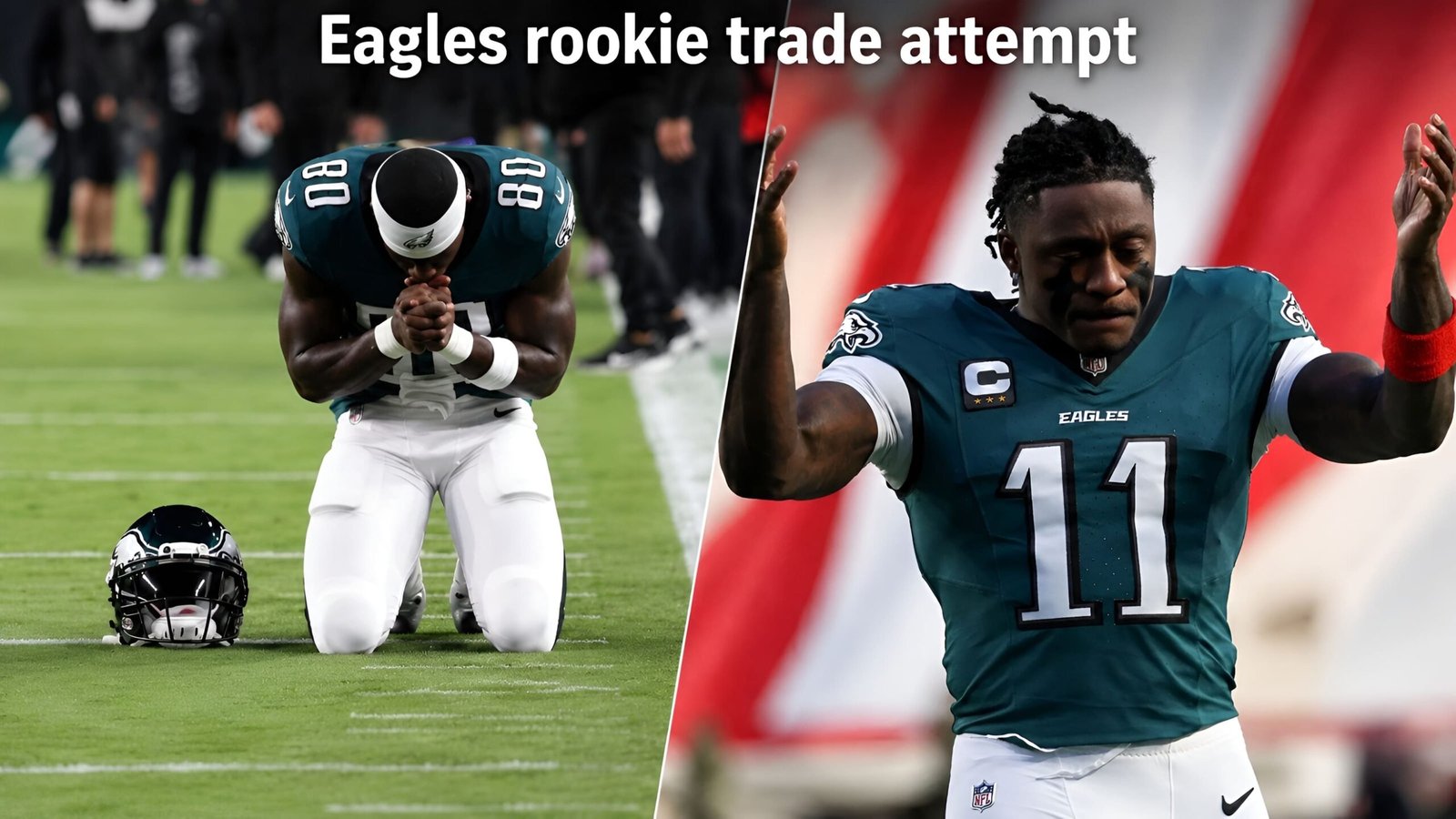
The Eagles rookie trade attempt refers to Philadelphia’s calculated move during the 2025 NFL Draft, where the team first tried to trade up as high as pick No. 18, then successfully moved from pick No. 32 to No. 31 by trading with the Kansas City Chiefs to secure Alabama linebacker Jihaad Campbell. It was a disciplined, value-driven decision that paid off with Campbell recording 80 tackles in his debut season.
| Full Name | Jihaad Campbell |
| Date of Birth | February 24, 2004 (Age 22) |
| Hometown | Erial, New Jersey |
| College | University of Alabama |
| Position | Inside Linebacker (ILB) |
| Height / Weight | 6’3″ / 235 lbs |
| Draft Year | 2025 NFL Draft |
| Draft Pick | Round 1, Pick #31 (Philadelphia Eagles) |
| College Honors | First-Team All-SEC 2024; Butkus Award Semifinalist |
| 2025 Rookie Stats | 80 Tackles, 1 INT, 1 FF, 1 FR |
| PFF Grade (2025) | 13th-best LB out of 88 rated |
| Current Team | Philadelphia Eagles (#30) |
Who Is Jihaad Campbell?
Jihaad Campbell is a 22-year-old inside linebacker from Erial, New Jersey — a small town just a short bridge-crossing away from Lincoln Financial Field in Philadelphia. Growing up in the shadow of an NFL stadium, Campbell always had a connection to professional football that felt almost destined. He earned a scholarship to the University of Alabama over powerhouse programs like Clemson, Georgia, Florida, and Texas A&M, choosing the Crimson Tide as the platform to prove himself at the highest collegiate level possible.
At Alabama in 2024, Campbell was nothing short of extraordinary. He led the entire team with 117 tackles, posted 11.5 tackles for loss, and recorded five sacks — extraordinary numbers for an off-ball linebacker. He was named First-Team All-SEC and became a Butkus Award semifinalist, the prize given annually to college football’s finest linebacker. Despite a labrum surgery in March 2025 creating brief pre-draft uncertainty, he recovered fully by training camp and immediately validated every dollar Philadelphia invested in him.
What Exactly Was the Eagles Rookie Trade Attempt and Why Did It Happen?
The term “Eagles rookie trade attempt” describes a series of calculated, aggressive behind-the-scenes moves Philadelphia’s front office made during the 2025 NFL Draft to secure Jihaad Campbell before any other team could. Reports surfaced that the Eagles actually attempted to trade up as high as the No. 18 overall pick to guarantee they would get Campbell — a move that would have cost significantly more in draft capital. That larger deal never materialized, but it revealed just how highly the organization valued the Alabama product.
Philadelphia originally held pick No. 32, the final selection of the first round. That late positioning made them vulnerable to any team ahead of them selecting Campbell first. Rather than trust luck, general manager Howie Roseman engineered a trade with the Kansas City Chiefs — sending picks No. 32 and No. 164 — to move up a single spot to No. 31. On the surface, it was a modest move. In context, it was a precision strike born from real conviction about one player’s long-term value to the defense.
80
2025 Tackles
#31
Draft Pick
13th
PFF LB Rank
117
College Tackles ’24
Understanding Howie Roseman’s Philosophy Behind the Trade Move
To understand why the Eagles made this draft-night maneuver, you have to understand how Howie Roseman operates. The Eagles’ general manager has built a reputation over more than a decade for being aggressive at the right moments — not recklessly, but strategically. Roseman views the draft as a chess match, where information, timing, and nerve determine outcomes. When the Eagles’ scouting staff identified Campbell as a first-round-quality talent who might slip due to his labrum surgery, Roseman’s instinct was to protect the acquisition rather than gamble on availability.
Roseman’s approach is also rooted in the idea that premium defensive talent, particularly at linebacker, is exceedingly difficult to find in free agency at comparable value. By investing a first-round pick and a sixth-round selection to move up one spot, Philadelphia avoided the catastrophic scenario of watching Campbell go to a division rival or a contending team at No. 32. The cost was modest, the upside was enormous, and the logic was the same that has defined Philadelphia’s sustained run of organizational competitiveness through multiple coaching regimes.
“Campbell was considered a top-20-level prospect by most evaluators — the Eagles essentially got a top-20 pick at No. 31.”— NFL Network Analyst Brian Baldinger, post-draft coverage
Jihaad Campbell’s College Career at Alabama and What Made Him a First-Round Target
Campbell’s path to the NFL was paved entirely through Alabama, one of the most demanding environments for a linebacker prospect in all of college football. Across his time with the Crimson Tide, he developed into the kind of multi-dimensional defender that modern NFL offenses punish teams for lacking. He wasn’t just a thumper near the line of scrimmage — he could drop into coverage, track tight ends down the seam, and arrive in the backfield with burst and power. Those qualities are extremely rare in a player of his size, which is precisely why NFL teams began treating him as a premium commodity.
In his final college season, Campbell ranked fifth in the entire SEC for total tackles — remarkable for a conference that houses some of the most talented offensive players in the country. He was named a second-team All-American by the Football Writers Association and became just the second off-ball linebacker selected in the first round by Philadelphia since Jerry Robinson way back in 1979. The fact that the Eagles were the only franchise willing to move up specifically for him — despite his perceived top-20 talent — made the entire story even more compelling from a roster-building perspective.
Draft Night Timeline: How the Pick No. 32 to No. 31 Trade Unfolded
On draft night in 2025, Philadelphia’s war room was on high alert as the first round moved deeper into the 20s. Campbell remained on the board longer than many analysts had projected — largely because of concerns surrounding his March labrum surgery. Teams with picks in the mid-to-late first round were reportedly hesitant, unsure whether Campbell would be ready by Week 1 of the regular season. The Eagles’ medical staff had done deeper due diligence, however, and reached the conclusion that his recovery trajectory was strong and his readiness for training camp was near-certain.
Once the Eagles confirmed Campbell was still available heading into the final stages of Round 1, Roseman activated the contingency plan. A call was placed to Kansas City, a deal was struck with remarkable speed, and Philadelphia moved from pick No. 32 to No. 31 by parting with a modest sixth-round pick. Campbell was selected with the No. 31 overall pick, and he learned of his new home while attending a pre-draft event in Green Bay, Wisconsin. Within 24 hours he was on a flight back to the state where he grew up, arriving in Philadelphia to begin his professional career.
Key Facts: The Draft Trade Breakdown
- Eagles held Pick No. 32 — last pick of Round 1
- Trade partner: Kansas City Chiefs
- Eagles sent: Pick No. 32 + Pick No. 164
- Eagles received: Pick No. 31
- Campbell grew up in Erial, NJ — near Lincoln Financial Field
- He was the first off-ball LB drafted R1 by PHI since 1979
- Eagles had reportedly explored moving up to as high as No. 18
Why Campbell’s Labrum Surgery Nearly Derailed His First-Round Status
In March 2025, just weeks before the NFL Combine and pre-draft evaluations ramped up, news broke that Jihaad Campbell had undergone labrum surgery. In the draft community, injury news of that nature can send a prospect’s stock into freefall — teams become gun-shy about committing first-round resources to a player who may miss significant time. For several franchises, the risk-reward calculation simply didn’t pencil out. The concern was that Campbell might start the season on the Physically Unable to Perform (PUP) list, costing an organization both roster flexibility and on-field production in the critical first weeks of the year.
In hindsight, those fears were dramatically overblown. Campbell was fully cleared and participating in Eagles training camp by July 23, well ahead of the regular season opener. Eagles defensive coordinator Vic Fangio, one of the most respected defensive minds in NFL history, immediately expressed confidence in Campbell’s readiness during the opening days of camp. The labrum scare, rather than being the story of Campbell’s early career, became little more than a footnote — and a reminder that franchises willing to trust their own medical evaluations over draft-room groupthink can uncover exceptional value.
Jihaad Campbell’s Rookie Season Performance: Numbers That Justified the Move
Campbell’s debut professional season was a genuine success story. He started 10 of the Eagles’ regular-season games, recording 80 total tackles alongside one interception, one forced fumble, and one fumble recovery. Pro Football Focus graded him as the 13th-best linebacker out of 88 rated players across the entire league — a remarkable achievement for any first-year player, let alone one who entered the season with pre-draft health questions hanging over his head. His versatility proved even more useful than anticipated: while he was projected as a downhill run-stopper, he excelled most notably in pass coverage.
By the midpoint of the season, The Ringer’s NFL analysis team had named him one of the top rookie linebackers in football, noting that through eight games he had registered 45 tackles, one interception, one forced fumble, and two pass breakups. He demonstrated the ability to match up with tight ends in coverage — one of the most difficult skills for any linebacker to master — and consistently took away the middle of the field from opposing quarterbacks. In his very first NFL game against the Dallas Cowboys, Campbell was named Philadelphia’s best newcomer performer by ESPN after posting three tackles and a forced fumble on 57 defensive snaps.
The Role Shift: How Nakobe Dean’s Return Affected Campbell’s Playing Time
Campbell’s rookie season was not without its complications. For the first seven weeks, he started exclusively at inside linebacker alongside Zack Baun, filling the role vacated by Nakobe Dean during his injury rehabilitation. During that stretch, Campbell looked every bit like a potential Defensive Rookie of the Year candidate. His instincts, athleticism, and coverage ability were generating real buzz across the league. Then Dean returned from injury, and the Eagles faced a roster depth problem that most franchises would be envious to have — too many capable linebackers for a standard two-linebacker defense.
As Dean worked his way back into the starting lineup, Campbell’s defensive snap count declined each week. The situation reached an unusual low point during a late-season game against the Chicago Bears when Campbell recorded zero defensive snaps — appearing only on special teams. Critics questioned whether the Eagles were mismanaging their first-round investment, while others pointed out that the situation reflected Vic Fangio’s commitment to earning snaps through practice performance rather than draft pedigree alone. Campbell handled the situation with professionalism and bounced back to contribute meaningfully in subsequent games, including recovering a crucial fumble in a win over the Buffalo Bills.
How the Eagles’ Defensive Coordinator Vic Fangio Shaped Campbell’s Development
One of the most underappreciated elements of the Eagles’ decision to trade up for Campbell was the presence of Vic Fangio as defensive coordinator. Fangio, who has spent decades building championship-caliber defenses across multiple NFL organizations, is widely regarded as one of the premier developmental minds for defensive players in the modern game. His defensive system places enormous emphasis on linebacker intelligence — reading formations, disguising coverages, and attacking offensive concepts rather than individual assignments. For a player with Campbell’s athleticism and instincts, Fangio’s system was an ideal fit from day one.
Fangio’s influence helped accelerate Campbell’s transition from college star to professional contributor at an unusually fast pace. While many first-round linebackers require a full season before they can be trusted in high-leverage coverage situations, Campbell was operating in genuine man coverage against NFL tight ends within the first month of the regular season. Fangio’s public comments about Campbell at the start of training camp — calling him a player with long-term starter potential — set a tone of confidence that the rest of the defensive unit fed off of throughout the year. The pairing of a great coach and a highly motivated rookie proved to be one of the quiet success stories of Philadelphia’s 2025 campaign.
Comparing the Eagles Rookie Trade Attempt to Philadelphia’s Historical Draft Aggression
The Eagles have a long and storied history of making bold, sometimes polarizing moves during the NFL Draft. From trading up to select Carson Wentz with the second overall pick in 2016 to the blockbuster trade for the No. 1 selection to take Jalen Hurts in subsequent draft decisions, Philadelphia’s front office has never been afraid to spend draft capital when it believes the value justifies the price. The 2025 trade for Campbell fits neatly within this tradition — but with one key difference: it was remarkably cost-efficient compared to the franchise’s previous big swings.
Moving from pick No. 32 to No. 31 for just a sixth-round pick is one of the most inexpensive first-round upgrades in recent Eagles draft history. The organization demonstrated that aggression does not have to be reckless — that patience, evaluation, and precision can accomplish the same roster-building goals as a splashy, expensive trade-up. Campbell’s successful rookie campaign validated this philosophy entirely. In retrospect, the move stands as a textbook example of how to manufacture value in the final stages of the first round: identify a talent gap between perception and reality, exploit it efficiently, and trust your own process when the broader market hesitates.
The Broader Impact: What Campbell’s Presence Means for Philadelphia’s Defense in 2026
Looking ahead to 2026 and beyond, Jihaad Campbell’s development trajectory is one of the most exciting storylines on Philadelphia’s roster. He enters his second professional season having already established himself as a legitimate starter at the inside linebacker position and having demonstrated measurable growth in some of the most difficult technical areas of his game. If Nakobe Dean’s injury history continues to be a factor — as it has been across multiple seasons — Campbell could find himself as the full-time starter alongside Zack Baun, with the depth and flexibility to slide to different alignment positions depending on the game plan Fangio designs each week.
Beyond the immediate starter competition, Campbell’s contract structure as a first-round pick means Philadelphia controls his rights at a below-market rate for five years if they exercise the fifth-year option. That financial efficiency gives the Eagles enormous flexibility to invest resources at other premium positions — receiver, offensive line, or the defensive secondary — without worrying about linebacker being a budget drain. In the modern salary-cap era of the NFL, securing a proven starter at linebacker cost-effectively for half a decade is not just a football win. It is a financial win that compounds positively across the entire roster construction process.
What NFL Analysts Said About the Trade and Campbell’s Future Ceiling
The draft community’s reaction to Philadelphia’s move was a mix of surprise and admiration. NFL Network analyst Brian Baldinger noted on draft night that moving up one spot to select what many considered a top-20 talent was a savvy piece of business — and that the cost of a late sixth-round pick made the trade look even smarter in retrospect. Several national draft experts noted that Campbell’s labrum surgery had artificially suppressed his draft stock, and that organizations willing to trust independent medical evaluations rather than market fear were likely to benefit from his performance.
By the midpoint of the 2025 season, the consensus had shifted even more firmly in Philadelphia’s favor. ESPN’s power rankings cited Campbell as the Eagles’ best newcomer performance of the year after a dominant Week 1 showing. Pro Football Focus, one of the most data-driven player evaluation platforms in the sport, ranked him as a top-15 linebacker nationally through the first half of the season. Looking further ahead, multiple analysts have projected Campbell as a Pro Bowl-caliber player within two to three seasons if his development arc continues at its current pace — a ceiling that would make the pick No. 31 trade one of the best value moves in that entire draft class.
Community Reaction: Eagles Fans and the City of Philadelphia Embrace Their Hometown Hero
Perhaps no element of the Jihaad Campbell story resonates more deeply with Philadelphia’s fanbase than the geographic dimension. Erial, New Jersey, sits just across the Delaware River from Lincoln Financial Field — the stadium where Campbell watched Eagles games as a child growing up in South Jersey. For a city that has always prized authentic local connections, drafting a player with genuine roots in the region carries cultural weight that goes beyond football statistics. Campbell’s arrival was celebrated not just as a roster move but as a homecoming, and that emotional connection has made him a fan favorite from the moment his name was announced on draft night.
Eagles fans have a tradition of connecting viscerally with players who embody toughness, passion, and a chip-on-the-shoulder mentality. Campbell checks every one of those boxes. He was overlooked by much of the league due to an injury, he was drafted later than his talent warranted, and he came back to the region where he grew up to prove himself on the grandest possible stage. In his first NFL regular-season game, he delivered with 57 defensive snaps and a forced fumble. That is the kind of performance that creates a bond between a player and a city that money and marketing cannot manufacture — it has to be earned, and Campbell earned it immediately.
How Jihaad Campbell Fits the Profile of a Modern NFL Linebacker
The NFL linebacker position has undergone a dramatic transformation over the past decade. The old archetype — a large, downhill thumper who excelled near the line of scrimmage but was a liability in coverage — has become increasingly obsolete as offenses spread the field and deploy athletic tight ends and pass-catching backs in creative ways. What teams desperately need today is the rare linebacker who can do both: stop the run with physicality and force, and then turn around and cover the seam receiver or tight end in man coverage without being exploited. That dual-threat profile commands a premium in today’s NFL, and it is precisely what Jihaad Campbell offers.
At 6’3″ and 235 pounds, Campbell has the frame of a traditional run-stopper but the athleticism and movement skills of a coverage linebacker. His college tape at Alabama showed him locking up receivers in space, tracking running backs out of the backfield, and disrupting timing routes at the second level. His rookie NFL season validated all of that, with Philadelphia’s own Vic Fangio building coverage concepts specifically around his abilities in the middle of the field. As the league continues evolving schematically, Campbell’s versatility will only become more valuable — and the Eagles knew that when they made the calculated decision to move up and ensure no one else could take him first.
Conclusion: A Small Trade with a Very Large Story
The story of the Eagles rookie trade attempt is ultimately a story about conviction. Philadelphia identified a talent that the broader market had undervalued, conducted their own independent medical evaluation, reached a confident conclusion, and then executed efficiently to protect the outcome they wanted. Moving from pick No. 32 to No. 31 for a sixth-round selection will never be the flashiest transaction in Eagles history — but it may prove to be one of the most important. Jihaad Campbell delivered an impressive debut season, earned a top-15 PFF linebacker grade nationally, and gave Philadelphia a versatile defensive cornerstone around which Vic Fangio can build for years to come.
The connection between a hometown kid from South Jersey and the city of Philadelphia adds a layer of meaning that pure analytics cannot capture. As Campbell enters his second season with the Eagles, the expectations are higher, the competition at linebacker is deeper, and the spotlight is brighter. But based on everything he showed as a rookie, Philadelphia made exactly the right call — both on the phone with Kansas City and on the draft board. Sometimes the best moves in professional football are not the loudest ones. They are the precise ones.
Frequently Asked Questions (FAQs)
What was the Eagles rookie trade attempt in 2025?
It refers to Philadelphia’s effort during the 2025 NFL Draft to move up the draft board to select linebacker Jihaad Campbell. The Eagles tried as high as pick No. 18 before completing a smaller trade from No. 32 to No. 31 by dealing with the Kansas City Chiefs.
Who is Jihaad Campbell and where is he from?
Jihaad Campbell is a 22-year-old inside linebacker born on February 24, 2004, in Erial, New Jersey — just across the river from Philadelphia. He played college football at the University of Alabama and was drafted 31st overall by the Eagles in 2025.
What did the Eagles give up to move up and select Campbell?
Philadelphia traded pick No. 32 (the final pick of Round 1) and pick No. 164 (a sixth-round selection) to the Kansas City Chiefs in exchange for pick No. 31.
How did Jihaad Campbell perform in his rookie NFL season?
Campbell recorded 80 tackles, one interception, one forced fumble, and one fumble recovery in his rookie season. Pro Football Focus graded him as the 13th-best linebacker out of 88 rated players league-wide.
Why did Campbell fall in the 2025 NFL Draft despite being a top talent?
Campbell underwent labrum surgery in March 2025, which created uncertainty about his availability for the start of the regular season. Many teams shied away as a result, allowing him to slide further than his talent level would normally dictate.
Was Campbell the first off-ball linebacker taken in Round 1 by the Eagles in a long time?
Yes. Jihaad Campbell was the first off-ball linebacker selected in the first round by Philadelphia since Jerry Robinson in 1979 — a gap of over four decades at the position in Round 1.
What is Campbell’s projected role with the Eagles going forward?
Campbell is projected to compete for a full-time starting inside linebacker role in 2026 alongside Zack Baun. His versatility in coverage and against the run gives Vic Fangio multiple ways to deploy him, and the Eagles hold his rights affordably through the fifth-year option of his rookie contract.
