
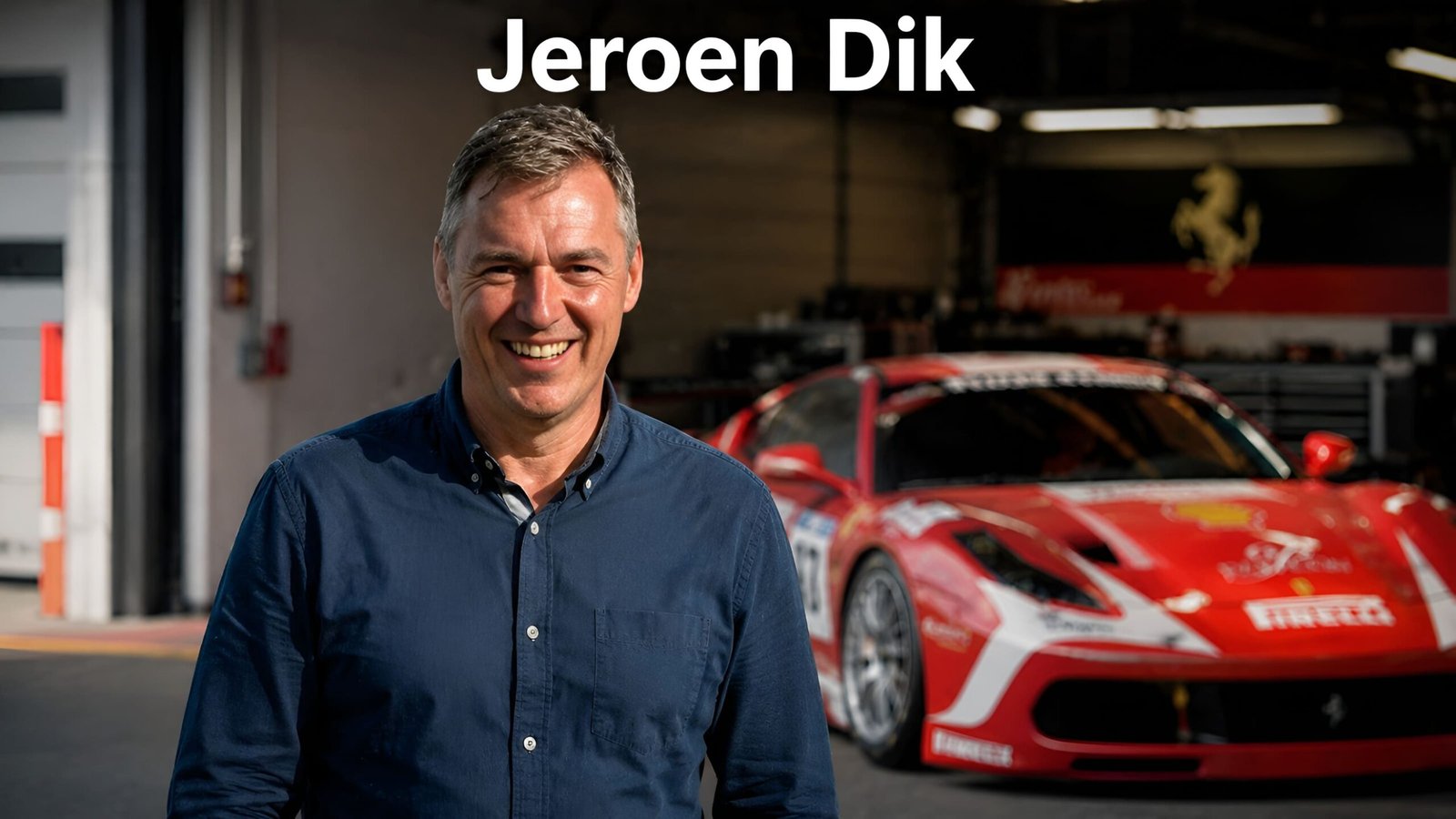
Jeroen Dik is a Dutch professor and materials scientist at Delft University of Technology (TU Delft). He is globally recognised for using non-invasive imaging technologies — including MA-XRF and synchrotron scanning — to reveal hidden compositions beneath famous paintings by Van Gogh, Vermeer, and Rembrandt, without causing any damage to the artwork.
Quick Bio Table
| Detail | Information |
| Full Name | Jeroen Dik |
| Nationality | Dutch (Netherlands) |
| Profession | Professor & Materials Scientist |
| Institution | Delft University of Technology (TU Delft) |
| Title | Antoni van Leeuwenhoek Professor of Materials in Art and Archaeology |
| Specialisation | MA-XRF scanning, non-invasive imaging, heritage science |
| Notable Work | Hidden portrait under Van Gogh’s Patch of Grass; Vermeer’s Girl with a Pearl Earring |
| Education | PhD in Chemistry |
| Media Coverage | BBC News, National Geographic, The Guardian |
Who is Jeroen Dik?
Jeroen Dik is not your typical laboratory scientist. Born and educated in the Netherlands, he built a remarkable career at the crossroads of materials science and fine art. As the Antoni van Leeuwenhoek Professor of Materials in Art and Archaeology at TU Delft, his work centres on one extraordinary goal — to look beneath the surface of history’s greatest paintings and reveal what has been hidden for centuries. His name has become synonymous with discovery, precision, and deep respect for cultural heritage.
What separates him from most scientists is genuine fluency in both worlds. He understands the chemistry of pigments and the physics of X-ray beams, while equally grasping the historical significance of a Rembrandt underdrawing or a lost Van Gogh portrait. This rare duality — speaking the language of atoms and art history simultaneously — has made him one of the most influential heritage researchers of his generation.
Academic Background: How Chemistry Became the Key to Unlocking Art History
Dik’s foundation in chemistry gave him an analytical toolkit that traditional art historians simply do not possess. His doctoral research at TU Delft built deep knowledge of how materials behave at a molecular level — understanding that proved invaluable when applied to centuries-old pigments, paint layers, and varnishes. This scientific grounding allows him to answer questions that no art historian alone could approach with confidence.
TU Delft, one of Europe’s finest institutions for engineering and applied sciences, became the ideal home for this boundary-breaking research. There, Dik built working relationships with physicists, chemists, conservators, and art historians — reinforcing his belief that meaningful discoveries only happen when disciplines collaborate honestly and openly.
MA-XRF Technology: The Tool That Transformed Art Conservation
Macro X-ray Fluorescence — MA-XRF — is the most important technology in Dik’s research toolkit. The technique directs a focused X-ray beam across a painting’s surface. Different chemical elements in the paint absorb and re-emit energy at distinct wavelengths, allowing researchers to map elemental composition across the entire canvas — including layers painted over and completely invisible to the naked eye.
Before MA-XRF, studying hidden layers often required physically removing tiny paint samples — a process carrying real risk of permanent damage. Dik championed non-invasive methods that eliminate this risk entirely, setting a new ethical and scientific standard for art conservation that museums worldwide have since adopted.
The Van Gogh Discovery: A Hidden Peasant Woman Beneath Patch of Grass
One of the most celebrated moments in modern art history came when Dik and colleague Professor Koen Janssens directed a synchrotron-based XRF scanner at Van Gogh’s 1887 painting Patch of Grass, held at the Kröller-Müller Museum. What appeared to visitors as a sunlit field concealed beneath its surface a detailed portrait of a peasant woman — painted in Van Gogh’s earlier, darker style.
The discovery provided genuine historical insight. Art historians estimate roughly one-third of Van Gogh’s early works cover earlier compositions, because the artist frequently could not afford fresh canvas. This finding confirmed that fact scientifically, while also revealing how his palette evolved from sombre Dutch earth tones toward the vibrant Impressionist colours of his Paris period.
The Vermeer Project: Three Centuries of Invisibility, Reversed by Science
In 2018, Dik’s team contributed to the “Girl in the Spotlight” project at the Mauritshuis museum — a scientific examination of Vermeer’s Girl with a Pearl Earring. Using optical coherence tomography and MA-XRF analysis, they studied the painting’s chemistry and surface with unprecedented detail.
The findings were remarkable. The background, long appearing as plain dark surface, was originally painted with a rich green curtain that faded completely over 350 years. Even more strikingly, the Girl was found to have eyelashes — invisible to previous observers, hidden by centuries of varnish. These discoveries fundamentally changed scholarly understanding of Vermeer’s original artistic vision.
Forgery Detection: When Science Exposes What the Eye Cannot See
Among the most commercially significant applications of Dik’s methods is art forgery detection. The art market loses substantial sums annually to sophisticated fakes. Chemical analysis via MA-XRF can expose frauds with remarkable reliability, because certain pigments simply did not exist before specific historical dates.
Titanium white was not produced commercially until the early twentieth century. If MA-XRF detects titanium in a painting claimed to be seventeenth-century, the attribution is immediately disproven. Similarly, Prussian blue was invented in 1704 and synthetic ultramarine in 1826. The chemical timeline of artists’ materials provides a forensic tool of extraordinary power and precision.
Education and Legacy: Training the Next Generation of Heritage Scientists
Beyond research, Dik is deeply committed to teaching. At TU Delft, he trains students to bridge science and culture — to read a painting as both a material object and a historical document, and to apply rigorous analytical methods with sensitivity to cultural significance.
His students work on actual collection objects within real museum partnerships, not just laboratory test samples. Many have gone on to careers in major museums and conservation institutes worldwide. By training this generation in both the technical and humanistic dimensions of heritage science, Dik ensures his influence extends far beyond his own discoveries.
Conclusion: A Legacy Written in Recovered Stories and Hidden Pigments
Jeroen Dik has spent his career listening to stories no one else could hear — encoded in mercury traces and antimony signals, written in the layered chemistry of paint applied by hands still for centuries. Through scientific rigour, ethical commitment to non-destructive analysis, and inspired museum partnerships, he has permanently changed how humanity understands and preserves its greatest artistic achievements.
The hidden Van Gogh portrait, the faded Vermeer curtain, the underdrawings of Old Masters — these recovered chapters of human history exist in the public record today because one Dutch materials scientist chose to look beneath the surface. That is the enduring legacy of this remarkable researcher, and it will grow with every painting that still holds its secrets.
Frequently Asked Questions
Who is Jeroen Dik?
He is a Dutch professor and materials scientist at TU Delft, famous for using non-invasive imaging to reveal hidden layers in famous paintings.
What is MA-XRF?
Macro X-ray Fluorescence — a scanning technique that maps chemical elements in paint layers without touching or damaging the artwork.
What did he discover in Van Gogh’s Patch of Grass?
A hidden portrait of a peasant woman beneath the visible surface, proving Van Gogh regularly reused canvases due to financial hardship.
Did he work on Vermeer’s Girl with a Pearl Earring?
Yes. His team found the background was originally a green curtain, and that the figure has eyelashes — both invisible to previous observers.
Can his methods detect forgeries?
Yes. MA-XRF identifies pigments unavailable before certain dates, making it a highly reliable forensic tool for exposing art fraud.
What is synchrotron imaging?
A synchrotron is a particle accelerator generating intense X-ray beams. Dik uses synchrotron facilities like the ESRF in Grenoble for complex, deep-layer analysis.
Why is non-invasive analysis so important?
It allows deep scientific study of priceless artworks without any physical sampling or risk of damage — protecting cultural heritage while generating richer data.
