
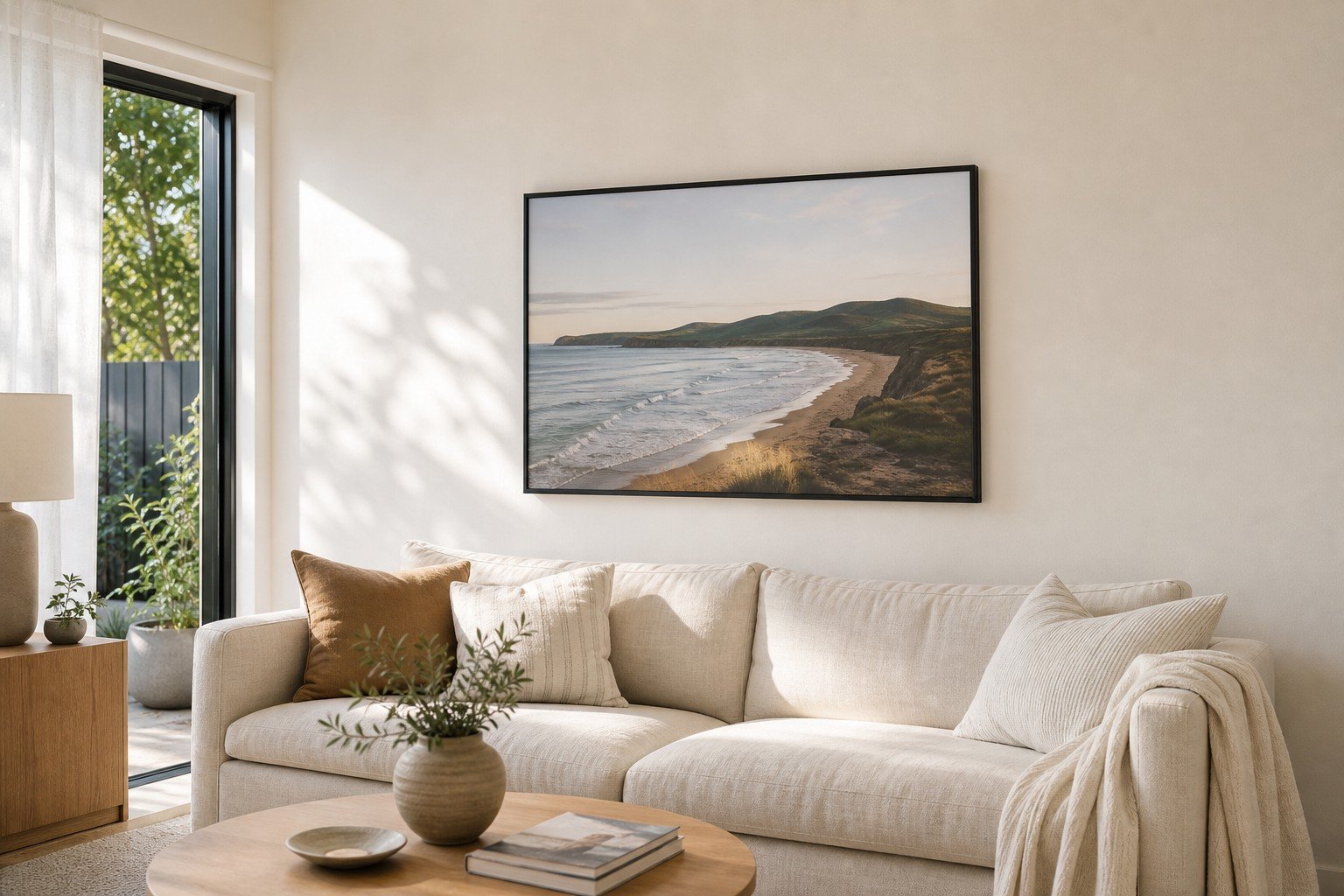
If you want one piece of wall art to change how a room feels, A1 is the size to look at. It is large enough to fill the space above a sofa or bed on its own, without the cost of a canvas or a commissioned piece.
A1 is also one of the most common print sizes of PhotoFramed in the UK. Exhibition posters, architectural drawings, maps and many online art prints are sold in it, so there is no shortage of things to put in the frame.
This guide explains what fits an A1 frame, how to choose a good one, and how to hang it safely.
What fits an A1 frame?
An A1 frame holds a print measuring 594 x 841 mm, or about 23.4 x 33.1 inches. As with all frames, the size refers to the artwork inside so the outside edge will be a few centimetres larger.
A1 belongs to the ISO 216 paper series. Each size is exactly half the one above it, and every size shares the same proportions. That makes it easy to mix A-series frames on one wall.
| Size | Dimensions (mm) | Fits an A1 frame? |
|---|---|---|
| A2 | 420 x 594 | Yes, with a mount |
| A1 | 594 x 841 | Yes, edge to edge |
| 60 x 80 cm | 600 x 800 | No, slightly too wide |
| 24 x 36 in (US poster) | 610 x 914 | No, too large |
The last two rows catch people out. A 60 x 80 cm or a US-sized movie poster looks close to A1 but will not fit, so measure the print before you order.
What people frame at A1
- Exhibition and gallery posters: Museum shops often sell prints at A1, and a frame turns a £20 poster into a proper piece of art.
- Maps: Ordnance Survey style maps, vintage city maps and travel maps all suit the size.
- Architectural and design drawings: Plans and technical drawings are commonly printed at A1, and they look striking framed in a home office.
- Photography: A favourite landscape or family photo printed at A1 makes a strong focal point.
- Children’s artwork and keepsakes: A large frame can hold several drawings arranged together on a single backing.
Choosing an A1 frame
Glazing matters most at this size
A sheet of glass this large is heavy, and if the frame falls it can shatter across the floor. For most homes, acrylic glazing (often called Perspex or plexiglass) is the better choice. It is far lighter, it does not shatter, and it is much easier to hang on plasterboard.
The trade-off is that acrylic scratches more easily than glass. Clean it with a soft microfibre cloth and mild soapy water, never kitchen roll or glass sprays containing ammonia.
Finish
- Black: the safe choice for posters, maps and graphic prints.
- White: clean and gallery-like, especially against darker walls.
- Oak or natural wood: softens a large piece and suits Scandinavian or neutral rooms.
- Rustic wood: works with vintage posters and cottage-style interiors.
Profile
At A1, a very thin moulding can look flimsy. A face width of around 20 to 30 mm gives the artwork enough presence and helps the frame stay rigid.
Price
Custom framing an A1 print with glass and a mount can cost well over £100. Ready-made A1 frames are far cheaper, typically ranging from about £12 to £60 depending on materials.
For posters and prints, a budget MDF frame with acrylic glazing does the job well. An A1 frame of this kind can be bought for under £15 from UK online frame shops. Keep bespoke framing for originals, signed prints, or anything you want to protect from fading.
Where to hang an A1 frame
Hang the frame so its centre sits at roughly eye level, about 145 to 152 cm from the floor. Above furniture, leave 15 to 25 cm between the top of the furniture and the bottom of the frame.
- Above a sofa: An A1 frame in landscape suits most two- and three-seater sofas. As a rough guide, art should span about two-thirds of the furniture’s width.
- Above a bed: Centre it over the headboard. Use acrylic glazing here, never glass.
- Hallway or landing: A portrait A1 frame fills a tall, narrow wall well, and it is visible from the stairs.
- Home office: A framed map or drawing behind the desk also looks good on video calls.
- Gallery wall: Use the A1 piece as the anchor and arrange A3 and A4 frames around it, with even gaps of about 5 to 8 cm.
Fitting and hanging safely
Large prints can crease or bow, so take your time.
- Clear a table or lay a clean sheet on the floor, and place the frame face down.
- Open the clips, lift out the backing and the glazing, and peel the protective film off both sides of the acrylic.
- Dust the inside of the glazing with a lint-free cloth.
- If a poster has been rolled, flatten it under books for a day or two first.
- Lay the print on the glazing, replace the backing, and close the clips. Check the front for dust before hanging.
Use two hooks rather than one for an A1 frame. Two fixings keep it level and spread the weight. On plasterboard, use proper plasterboard fixings, and check for pipes and cables with a detector before drilling.
Frequently asked questions
How big is an A1 frame in cm? It holds a 59.4 x 84.1 cm print. The frame’s outer dimensions are larger, depending on the moulding width.
Can I put an A2 print in an A1 frame? Yes. Use a mount with an A2-sized opening, which gives an even border all the way round because A-sizes share the same proportions.
Will a 60 x 80 cm print fit an A1 frame? No. At 60 cm wide, it is about half a centimetre too wide for the frame’s 59.4 cm opening.
Should I choose glass or acrylic for A1? For most homes, acrylic. It is lighter, shatterproof and safer above beds and in busy hallways.
The bottom line
An A1 frame is the simplest way to turn a poster, map or photo into a statement piece. Measure the print, choose acrylic glazing for safety, and hang it at eye level with two fixings. Done well, a frame costing less than a takeaway can anchor a whole room.
