
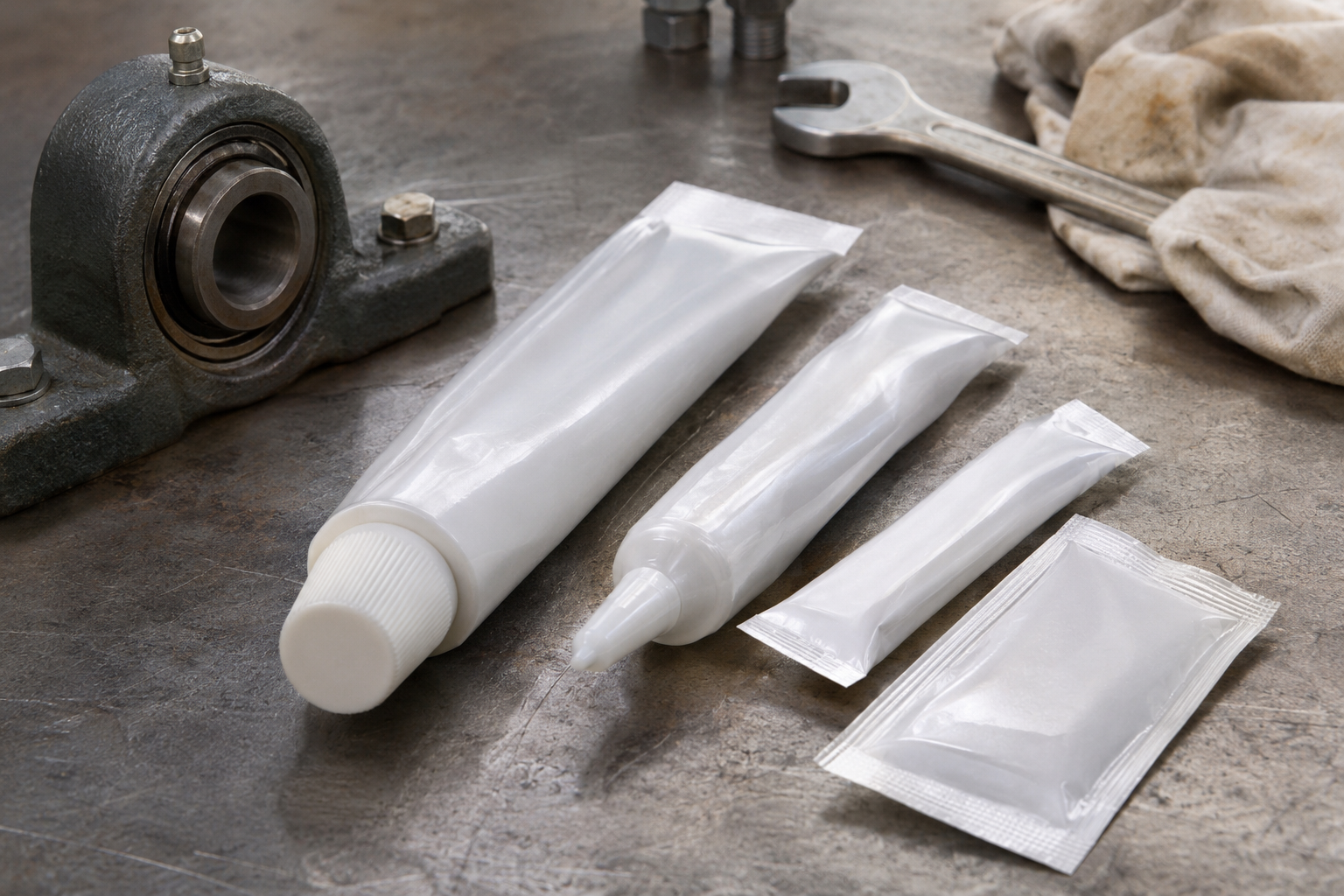
When a mechanic, engineer or maintenance technician needs a small amount of grease, a large container isn’t always the most practical option. The product might be needed for a single component, included in an assembly kit or applied in a confined space. In these situations, the packaging can make just as much difference to the job as the lubricant itself.
Choosing suitable lube packaging helps manufacturers supply products in quantities and formats that match how they will be used. From individual sachets to precision dispensing tubes, the right packaging can make application easier, reduce unnecessary waste and help protect the contents during storage and transport.
Packaging Needs to Match the Application
Not all lubricants behave in the same way. A thin oil flows differently from a thick grease, while a specialist paste may need to be applied to a very specific area. These differences influence which packaging format will work best.
For example, a small sachet might be suitable when the entire contents are needed for one maintenance task. However, when grease needs to be applied to a narrow opening or difficult-to-reach component, a tube with a directional nozzle may offer greater control. The user can squeeze the product directly onto the required area without transferring it from another container.
The amount of lubricant needed is equally important. Supplying more than the job requires can result in unused product being discarded, particularly when the packaging cannot be closed again. Manufacturers should therefore consider the typical application quantity before deciding on a fill size.
Understanding the Different Packaging Options
Sachets remain a practical choice for single-use applications. They are lightweight, relatively compact and can be included alongside replacement components, maintenance instructions or product samples. For businesses supplying automotive parts or industrial equipment, this makes them useful when a specific quantity of lubricant needs to accompany another product.
Tear-top tubes provide a different approach. Rather than opening a sachet and squeezing out the contents, the user removes the end of the tube to create a dispensing point. This can be helpful when working with thicker formulations or applying grease to a particular component. The narrow opening can provide better control over where the product goes.
Screw-cap and resealable tubes are worth considering when the contents are intended for more than one application. Being able to close the container after use can help protect the remaining product and reduce the chance of accidental leakage during storage.
There isn’t a single format that works for every lubricant. The most suitable choice depends on viscosity, application method, required quantity and how the product will be handled once it reaches the customer.
Why Filling Accuracy and Product Protection Matter
Packaging decisions don’t end with choosing a sachet or tube. Manufacturers also need to consider how consistently each container is filled and whether the materials are compatible with the formulation.
Measured quantities can be particularly useful for assembly and maintenance kits. If a component requires a specified amount of grease, supplying that quantity in an individual pack can make the process more straightforward. It also reduces the need for workers to measure lubricant from a larger container, although the application instructions still need to be followed.
The packaging must also protect its contents throughout distribution and storage. A damaged seal or unsuitable material could lead to leakage, contamination or deterioration of the product. Compatibility testing is therefore important, especially when dealing with formulations containing oils, solvents or other ingredients that may interact with packaging materials.
Clear labelling is another consideration. Product identification, application instructions, batch information and any required safety warnings should remain legible. For manufacturers supplying multiple products or formulations, reliable identification helps prevent mistakes and makes it easier to trace individual batches when necessary.
Considering Packaging Waste and Long-Term Practicality
Reducing packaging waste has become an important consideration for manufacturers, but smaller containers aren’t automatically the most environmentally responsible choice.
A single-use pack can reduce leftover lubricant when the entire quantity is needed for one application. On the other hand, using multiple small containers for a job that requires a larger volume may create unnecessary packaging waste. The best option depends on how the product is used and what happens to the packaging afterwards.
Material selection also deserves attention. Some packaging uses several layers to provide the strength, flexibility and barrier properties needed to protect the contents. These combinations can make recycling more complicated, so manufacturers should check the available options rather than assuming that every plastic or laminate pack can be recycled through conventional collections.
In the UK, packaging requirements also address the amount of material used, with packaging expected to have no more weight and volume than necessary to protect the product. This makes it worth reviewing packaging size, material choice and the amount of secondary packaging used during distribution.
Before committing to a particular format, manufacturers should consider how the lubricant will be applied, whether the contents need to be used all at once and how the empty packaging will be handled. Testing a sample with the actual formulation and intended application can reveal practical issues that may not be obvious from the packaging specifications alone.
A well-chosen pack should do more than hold the lubricant securely. It should make the product straightforward to identify, store and apply, while avoiding unnecessary material and unused contents. Those practical details can make a noticeable difference to both the manufacturer and the person using the product.
