
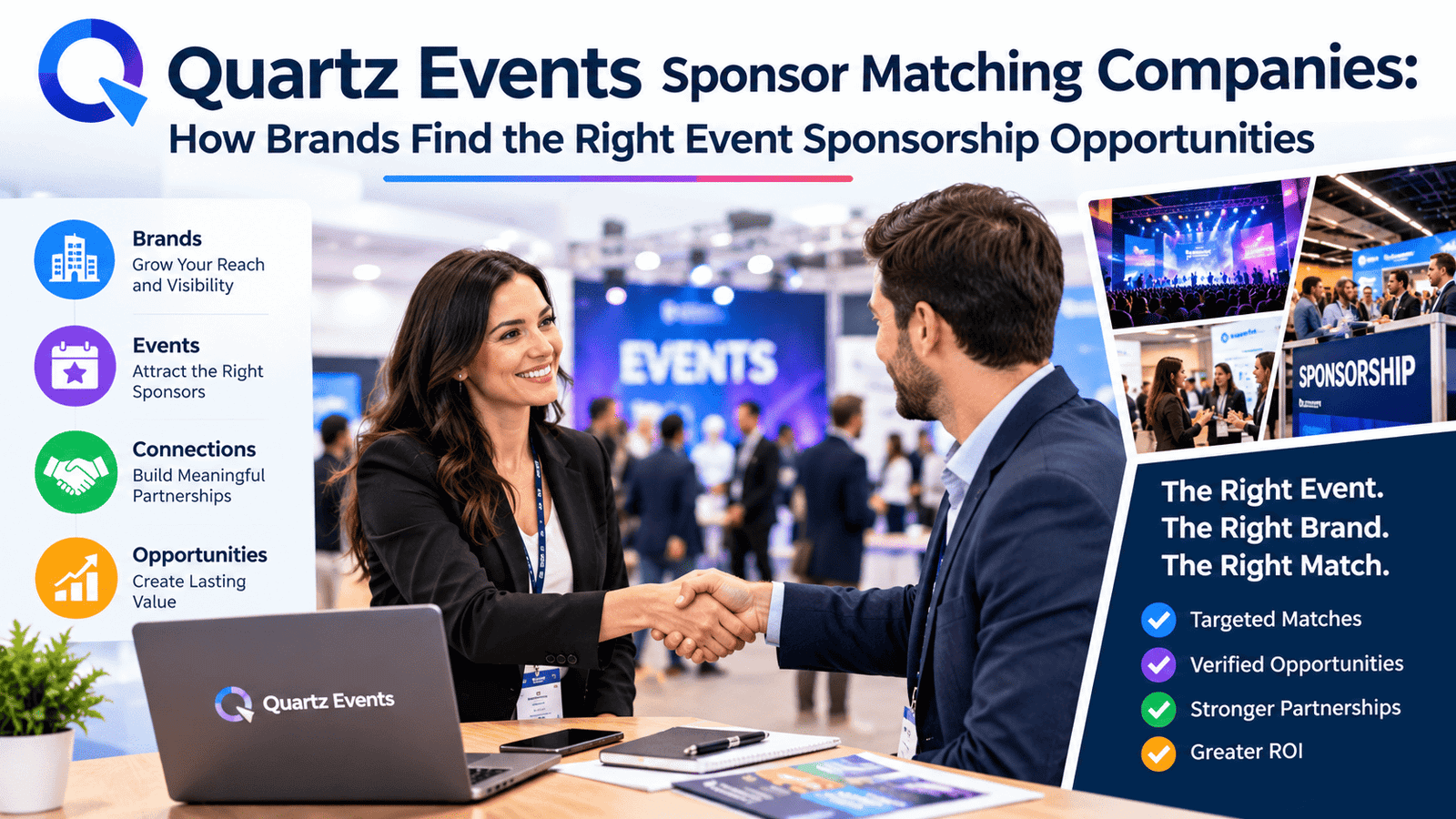
Quartz Events sponsor matching companies is a search term associated with the way Quartz Network connects business-to-business (B2B) solution providers with senior executives through curated business events and scheduled meetings. Instead of relying entirely on exhibition booths or general networking, this model focuses on connecting companies with professionals whose business needs may align with their products or services. It can help businesses explore relevant partnerships, build relationships with potential customers, and identify more focused sponsorship opportunities.
Introduction to Quartz Events Sponsor Matching Companies
Finding the right business audience is one of the biggest challenges in event marketing. Companies may invest significant time and money in conferences, exhibitions, and networking programs without knowing whether the people they meet are potential customers. This is where the concept of Quartz Events sponsor matching companies becomes relevant. It refers to the relationship between Quartz Network’s business events, sponsoring solution providers, and the executives who attend to explore ideas, services, and potential solutions for their organizations.
Quartz Network is associated with executive-focused business events that bring together professionals from different industries and corporate departments. Its approach emphasizes relevant connections between solution providers and business leaders rather than depending exclusively on traditional event advertising. The objective is to make professional conversations more purposeful by considering the interests, responsibilities, and business challenges of participating executives.
For companies exploring sponsorship opportunities, understanding this model can help them decide whether a structured business event is more suitable than a conventional trade show. The best choice depends on the target audience, the company’s objectives, the cost of participation, and the potential value of the relationships developed during the event.
What Are Quartz Events Sponsor Matching Companies?
The phrase can sound like the name of a directory containing independent sponsorship agencies. However, it is more accurately understood in the context of Quartz Network’s event sponsorship and business matchmaking model. The organization connects participating solution providers with executives who may be interested in researching products, technologies, services, or strategies relevant to their work.
A solution provider is a business that offers products or services to other organizations. Examples include enterprise software companies, cybersecurity providers, consulting firms, financial technology businesses, human resources platforms, and supply chain technology vendors. These companies often need direct access to decision-makers who understand their products and have a reason to consider them.
Sponsor matching attempts to create that connection through a more organized process. Rather than treating every event attendee as an equally valuable prospect, the approach considers whether a provider’s expertise matches an executive’s professional priorities. When the alignment is strong, the resulting conversation may be more useful to both parties.
It is important to distinguish this approach from the broader sponsorship industry. Traditional sponsorship services often help event organizers find brands willing to provide funding, products, or promotional support. Quartz Network’s documented model is primarily focused on connecting B2B solution providers with relevant business executives through curated meetings and professional events.
How Does the Quartz Event Sponsor Matching Process Work?
The process begins with understanding the audience and the business objectives of participating companies. An event designed for finance executives, for example, may attract organizations interested in financial planning, reporting, automation, risk management, or enterprise resource planning. A technology-focused event may address cybersecurity, cloud infrastructure, data analytics, or software development.
Once the event’s focus is established, participating solution providers can assess whether the audience fits their target market. Quartz describes its event model as involving qualified executives and scheduled one-to-one meetings. Depending on the specific program, sponsors may receive attendee information in advance and participate in arranging relevant conversations.
The next step is preparation. A company should understand the executive’s professional responsibilities, identify the problem its solution addresses, and develop questions that establish whether a genuine business need exists. This preparation makes the meeting more productive than a generic sales presentation that ignores the attendee’s priorities.
After the event, businesses can evaluate their conversations and follow up with appropriate prospects. A useful discussion may lead to a product demonstration, a request for further information, or a future commercial opportunity. However, a scheduled meeting does not automatically produce a sale. Results depend on the quality of the match, purchasing requirements, budget, timing, and the company’s ability to deliver a suitable solution.
Why Companies Consider Quartz Network Sponsorship
Companies choose event sponsorship for different reasons, including brand awareness, relationship building, lead generation, market research, and business development. The value of a sponsorship program depends on whether it supports the company’s specific objectives and reaches the people who influence purchasing decisions.
Quartz Network’s meeting-focused approach may be attractive to businesses that sell complex products or services to other organizations. Enterprise software, consulting, cybersecurity, and financial technology solutions often require detailed discussions before a buyer can evaluate them properly. A focused conversation with a relevant executive may therefore provide more value than a brief interaction with an unrelated visitor at a large exhibition.
Another potential benefit is preparation. When companies have useful information about prospective meeting participants, their representatives can develop more relevant questions and explain their solutions more clearly. This can make business discussions more efficient and help both sides determine whether further engagement is worthwhile.
Nevertheless, sponsorship should not be evaluated on meeting volume alone. Companies should also consider the relevance of the audience, the total participation cost, the quality of follow-up opportunities, and the amount of time required from their sales teams. A smaller number of relevant meetings can be more useful than a large number of conversations with people who have no interest in the solution.
Which Types of Companies May Benefit From Sponsor Matching?
Technology and Software Providers
Technology companies often sell products that require evaluation by IT leaders, technical managers, and other corporate decision-makers. These products may include cloud platforms, cybersecurity services, business intelligence tools, data management systems, and enterprise applications.
A technology provider attending a relevant Quartz Network event may have an opportunity to discuss business challenges directly with professionals responsible for evaluating such solutions. The key is to select an event whose audience matches the company’s ideal customer profile rather than assuming that every technology conference will produce suitable leads.
Finance and Financial Technology Businesses
Finance-focused events may be relevant to businesses offering accounting software, financial planning systems, payment technology, reporting tools, compliance solutions, or financial consulting. These providers generally need to understand an organization’s existing processes before recommending a solution.
A well-matched discussion can help the provider learn about operational priorities while allowing the executive to investigate potential improvements. Companies should still verify the event’s current audience, program, and sponsorship terms before deciding whether to participate.
Human Resources and Workforce Solutions
Human resources departments manage recruitment, employee development, payroll, workforce planning, performance, and retention. Companies offering HR software, recruitment technology, learning platforms, and employee management services may find professional events useful when the audience includes relevant HR leaders.
The strongest potential matches occur when a solution addresses a problem that an executive is actively evaluating. For example, a recruitment platform may be relevant to an organization improving its hiring process, while an employee learning system may be more suitable for a business focused on training and development.
Marketing and Customer Experience Companies
Marketing technology providers, customer analytics businesses, advertising platforms, and consulting firms may benefit from meeting executives responsible for customer acquisition, campaign performance, brand development, and customer experience.
A suitable event can create opportunities to discuss marketing challenges, data management, audience engagement, and measurement. However, the sponsor should be prepared to demonstrate how its solution addresses a specific business objective rather than relying on broad promotional claims.
Supply Chain and Operations Businesses
Supply chain and operations teams manage procurement, logistics, inventory, manufacturing processes, and supplier relationships. Technology companies and service providers working in these areas may benefit from events that attract executives responsible for operational efficiency.
Potential solutions include warehouse management systems, procurement platforms, logistics software, and business process consulting. Matching depends on the participating executives’ responsibilities and the problems they are interested in solving, so companies should review the focus of each event individually.
Quartz Events Sponsor Matching Companies vs. Traditional Trade Shows
Traditional trade shows and curated business events can both support business development, but they operate differently.
At a conventional exhibition, sponsors often pay for booth space, promotional materials, and other opportunities to display their products. They depend partly on attendee traffic to generate conversations. This approach can be useful for broad brand exposure, product demonstrations, and reaching a large audience.
A curated meeting-based event places greater emphasis on arranging conversations with relevant professionals. Instead of relying entirely on visitors approaching a booth, the program aims to connect solution providers with executives whose interests may align with their offerings.
Neither approach is automatically better. A consumer brand launching a widely available product may benefit from broad public exposure, while a company selling specialized enterprise software may prefer meetings with relevant corporate buyers. Businesses should compare the formats according to their goals, budget, sales cycle, and target audience.
The most appropriate sponsorship model is the one that creates measurable value for the business, not necessarily the one that promises the greatest number of attendees or meetings.
How to Evaluate a Quartz Event Sponsorship Opportunity
Before committing to an event, companies should define what success means for their participation. Some businesses want qualified sales opportunities, while others prioritize brand visibility, industry knowledge, professional relationships, or entry into a new market. Clear objectives make it easier to assess whether a particular event is appropriate.
The next consideration is audience quality. Sponsors should review the expected job titles, industries, company sizes, and professional responsibilities of attendees. They should also establish whether those attendees match the people involved in purchasing or recommending their products. A large audience is not necessarily valuable if very few participants fit the intended customer profile.
Costs and package details deserve equal attention. Companies should request a clear breakdown of sponsorship fees, included meetings, promotional benefits, travel requirements, and additional expenses. If a package includes scheduled meetings, the sponsor should clarify how meetings are selected, what happens when participants cancel, and what the organizer means by a qualified meeting.
Finally, businesses should ask for relevant case studies or references where available. Past results can help establish realistic expectations, although another company’s experience cannot guarantee the same outcome. A careful evaluation reduces uncertainty and makes it easier to compare Quartz Network with other event organizers.
Measuring the Results of Sponsor Matching
A sponsorship program should be evaluated through measurable business outcomes rather than impressions alone. The first useful measure is the number of meetings that actually take place with relevant prospects. This helps businesses determine whether the event delivered the access they expected.
The next measure is the number of conversations that progress into meaningful opportunities. For example, a meeting may lead to a follow-up call, a product demonstration, a formal proposal, or an invitation to participate in a purchasing process. Tracking these stages provides a clearer picture of the value created by the event.
Companies should also calculate the total cost of participation. This includes sponsorship fees, staff time, travel, preparation, and follow-up activities. Comparing these costs with qualified opportunities and eventual revenue helps businesses determine whether the investment supports their broader sales strategy.
Results may take time to appear, especially when products involve lengthy approval processes or substantial contracts. For this reason, companies should track both immediate outcomes and longer-term progress. A useful evaluation considers the quality of the relationships created, the strength of the sales pipeline, and the eventual commercial results.
Common Misunderstandings About Quartz Events Sponsor Matching Companies
One common misunderstanding is that sponsor matching guarantees new customers. In reality, an organized introduction creates an opportunity for discussion, not a guaranteed sale. Buyers still need to evaluate products, compare providers, obtain internal approval, and decide whether a purchase is appropriate.
Another misconception is that every company can benefit equally from this format. Businesses with clearly defined B2B customers and products that require professional evaluation may be better suited to executive-focused events than companies selling inexpensive consumer products to a general audience.
It is also important not to confuse attendee participation with sponsorship. An executive attending an event is not necessarily a sponsor, and a company represented in an event discussion is not automatically a sponsor of every program run by the organizer. Participation and sponsorship arrangements can vary by event.
Finally, companies should be cautious about unsupported performance figures. Any statistics about sponsor satisfaction, meeting guarantees, attendee numbers, or sales outcomes should be checked against current information from the organizer. Published promotional claims are useful starting points, but they should not replace independent evaluation or clear contractual terms.
The Future of Business Event Matchmaking
Business events are increasingly expected to provide more than a venue, a speaker program, and an exhibition area. Organizations want professional connections that are relevant to their responsibilities, while sponsors want to understand whether their participation can generate meaningful business opportunities.
Structured matchmaking responds to these expectations by placing greater emphasis on audience relevance, preparation, and scheduled conversations. Digital registration systems, attendee profiles, and business-interest information can help event organizers identify potential connections more efficiently. Their usefulness, however, depends on accurate information, appropriate matching criteria, and respect for participants’ preferences.
For sponsors, the continuing challenge is to balance efficiency with genuine relationship building. A successful business conversation should help both sides understand whether there is a practical reason to continue the relationship. Aggressive sales pitches and irrelevant introductions can undermine that objective, regardless of how sophisticated the event process may appear.
Quartz Network’s meeting-focused approach is one example of how business events can support more targeted professional connections. Companies considering this model should examine current event details, audience fit, and the terms of participation instead of assuming that every program will meet the same needs.
Conclusion
Quartz Events sponsor matching companies is a search phrase most closely associated with Quartz Network’s approach to connecting B2B solution providers with executives through curated events and scheduled business meetings. The model offers an alternative to relying exclusively on exhibition booths, general networking, or broad promotional exposure.
For technology vendors, consulting firms, finance providers, HR platforms, marketing businesses, and supply chain companies, the potential value lies in meeting professionals whose responsibilities and business challenges align with their solutions. However, the quality of those connections, the total cost, and the effectiveness of follow-up determine whether sponsorship produces meaningful results.
Businesses should evaluate each opportunity carefully, ask clear questions about meeting arrangements, and measure outcomes through qualified leads, sales opportunities, and long-term relationships. With realistic expectations and a well-defined strategy, event sponsorship can become a useful part of a broader B2B marketing and business development plan.
Frequently Asked Questions
1. What are Quartz Events sponsor matching companies?
The term generally refers to Quartz Network’s event sponsorship and matchmaking approach, which connects B2B solution providers with relevant business executives through curated events and scheduled meetings. It should not automatically be interpreted as the name of a directory of independent sponsorship agencies.
2. How does Quartz Network match sponsors with business executives?
Quartz describes an event model built around qualified participants, relevant solution providers, and planned one-to-one meetings. The exact process and available benefits can differ between events, so companies should confirm the current arrangements with the organizer.
3. Which businesses may benefit from Quartz event sponsorship?
Potentially suitable businesses include enterprise software providers, cybersecurity companies, consulting firms, financial technology businesses, HR technology vendors, marketing platforms, and supply chain solution providers. Suitability depends on whether the event attracts the decision-makers the company wants to reach.
4. Does Quartz event sponsorship guarantee sales?
No. A scheduled meeting can create a sales opportunity, but it does not guarantee a contract, customer, or specific revenue result. Outcomes depend on the buyer’s needs, product suitability, budget, purchasing process, and the sponsor’s follow-up.
5. What should companies check before sponsoring a Quartz event?
Companies should review the target audience, attendee qualifications, meeting arrangements, package inclusions, total costs, cancellation policies, and available evidence of previous sponsor outcomes. They should also define measurable objectives before making a commitment.
6. Is Quartz Network suitable for every type of business?
Not necessarily. Its executive-focused B2B format is most relevant to businesses selling products or services to organizations. Companies seeking broad consumer awareness may find that a different event or marketing channel better suits their goals.
