
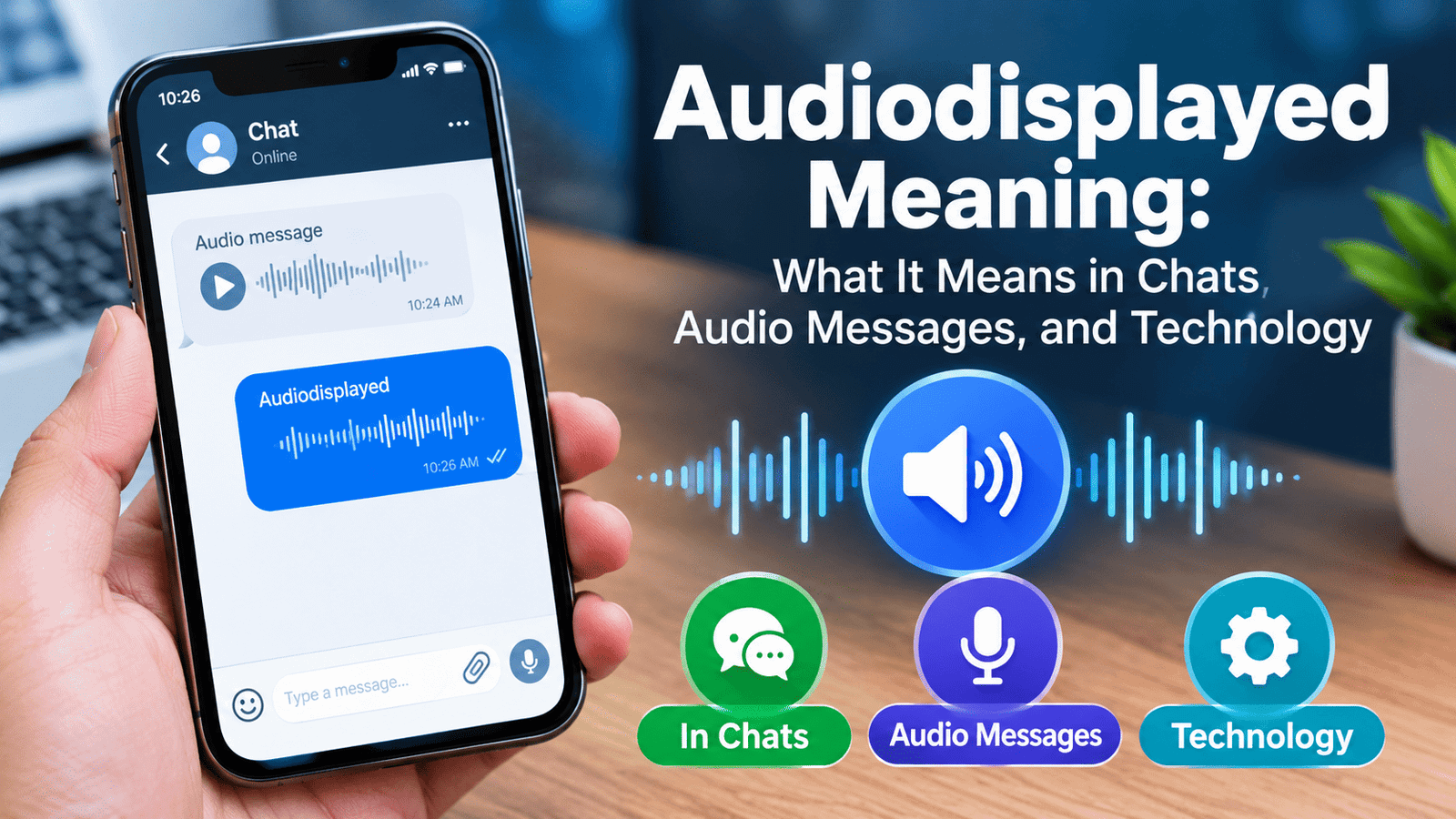
Audiodisplayed generally refers to audio content being shown or represented in a digital system. The term combines “audio,” which means sound or recorded speech, and “displayed,” which means shown or presented. You may encounter it in a chat transcript, exported conversation, technical interface, or AI-generated text record.
However, audiodisplayed does not automatically mean someone listened to an audio message. In some contexts, a label such as <<AudioDisplayed>> may serve as a placeholder showing where audio content appeared in a conversation. Its precise meaning depends on the application or system that produced it.
What Is Audiodisplayed?
Audiodisplayed is not a widely established everyday English word. It is better understood as a combined-word expression or a technical-style label associated with audio content.
To understand its meaning, consider the two words that form the expression.
- Audio: Sound content, including voice messages, spoken recordings, music, and other audio clips.
- Displayed: Something presented, shown, or represented in a digital interface or written record.
Together, these words suggest that an audio-related element has been displayed or represented somewhere in a digital environment.
For example, a conversation may contain written messages alongside a voice recording. When that conversation is converted into a plain-text transcript, the recording might be represented by a placeholder instead of appearing as an actual playable audio file.
A label such as <<AudioDisplayed>> can serve this purpose in certain transcript formats. It identifies the presence of audio-related content without necessarily providing the recording itself.
It is important not to assume that every application uses this label in the same way. Without knowing where the term appeared, its exact technical meaning cannot be confirmed.
What Does Audiodisplayed Mean in Chats?
In digital conversations, people exchange different types of content, including written messages, photographs, videos, voice notes, and audio attachments. When a conversation is copied, exported, or converted into text, some multimedia elements may not appear in their original form.
Instead, the resulting text may contain a label indicating where an audio item belongs.
For example:
Illustrative conversation
Alex: I want to share a voice message with you.
Alex: <<AudioDisplayed>>
Sam: I will check it later.
In this example, the marker represents an audio-related item between the written messages. It does not reveal what Alex said in the recording or whether Sam listened to it.
This distinction is useful when reviewing saved conversations. A text export can preserve the order of messages without containing every original attachment.
The exact interpretation still depends on the software that generated the transcript. A placeholder in a converted document may serve a different purpose from an audio status displayed directly inside a messaging application.
What Does <<AudioDisplayed>> Mean in a Transcript?
The expression <<AudioDisplayed>> looks like a placeholder or system-generated marker rather than ordinary conversational language.
A placeholder is a label used to represent an item that is not included directly in a document. For example, a text file might contain a marker for an image without displaying the image itself.
Audio can be represented in a similar way.
When a transcript includes an audio marker, it may indicate that an audio segment was present at that point in the original material. However, the marker itself does not contain the spoken words.
There are three important things to remember:
First, a marker is not necessarily the original audio file. It may simply identify where the audio appeared.
Second, a marker does not automatically provide a transcription. If the recording contains spoken words, those words must be transcribed separately.
Third, a marker does not confirm playback. It cannot independently establish whether another person started, completed, or even heard the recording.
If you encounter this format in a real transcript, check the source application or the export method to determine what the label represents.
Audiodisplayed Meaning in WhatsApp
The meaning of audiodisplayed in a WhatsApp-related context depends on where the wording appears.
A normal WhatsApp conversation can contain voice messages with their own playback controls. An exported or converted conversation, however, may represent media differently from the original chat interface.
For example, an exported text record might show a written message followed by an audio-related placeholder. The original conversation may have contained a voice message at that position, while the text file preserves only a marker.
This does not mean the recording has necessarily been deleted or damaged. The export may simply omit the actual audio content.
It is also important to distinguish a placeholder from an official message status. The appearance of the word audiodisplayed does not, by itself, establish that WhatsApp has confirmed someone listened to a voice message.
If you need to identify the exact meaning in a particular WhatsApp conversation, examine the original chat and determine how the text export was created.
Is Audiodisplayed a Real Word or Texting Slang?
Audiodisplayed is not widely recognized as standard English vocabulary or common texting slang.
It is different from familiar internet abbreviations such as LOL, BRB, and IDK, which have established meanings in informal communication.
Audiodisplayed looks more like a combined-word label that could be used in a technical environment, transcript, or data representation.
You may encounter variations such as:
- audiodisplayed
- AudioDisplayed
- audioDisplayed
- audio_displayed
- audio-displayed
- <<AudioDisplayed>>
These examples illustrate different formatting conventions. They should not be assumed to be official identifiers or interchangeable technical terms in every application.
In ordinary English writing, “audio displayed” would generally be more natural than writing the two words together. In a transcript or technical record, however, the original formatting may have a specific purpose.
Does Audiodisplayed Mean Someone Listened to Your Audio?
No. The appearance of audiodisplayed alone does not prove that someone listened to a recording.
This is one of the most important distinctions when interpreting audio-related labels in digital conversations.
An audio player can be visible on a screen without playback starting. Similarly, a transcript can include an audio placeholder without providing evidence that the recording was played.
Even when playback begins, that does not necessarily prove that someone heard the entire recording or paid attention to its contents.
Consider these differences:
| Term | General meaning |
| Audio displayed | An audio-related item is shown or represented |
| Audio available | An audio file or stream can be accessed |
| Audio played | Playback has started |
| Audio completed | Playback has reached its end, if tracked |
| Audio transcribed | Spoken content has been converted into written text |
| Message seen | A platform has recorded a viewing or reading event |
These descriptions are general explanations rather than universal platform-specific status definitions.
If you want to know whether someone listened to a voice message, look for the relevant playback indicators provided by the original application. Do not treat audiodisplayed alone as proof of listening.
Audiodisplayed vs. Audio Played: What Is the Difference?
Although the expressions look similar, displayed and played describe different things.
Audiodisplayed generally suggests that audio content has been shown or represented in a digital environment. Depending on the context, this could refer to a visible player, an attachment, or a placeholder in a transcript.
Audio played refers more directly to playback having started.
For example, a website can display an audio player before a visitor presses its play button. The player is visible, but the recording has not necessarily started playing.
A transcript can also identify an audio segment without playing the original recording.
The difference can be summarized simply:
- Displayed means shown or represented.
- Played means playback has started.
- Completed means playback has reached the end, if the system records that event.
- Listened to means a person heard the sound, something that cannot always be established from a technical status alone.
Understanding these differences prevents confusion when reading audio-related labels in transcripts, messaging applications, and other digital systems.
Why Does Audiodisplayed Appear in a Chat Export?
A chat export converts a conversation into a format that can be saved, reviewed, or shared outside the original application. Depending on the export method, the resulting document may preserve written messages while representing images, audio clips, or other attachments with placeholders.
There are several possible reasons an audio-related label might appear.
The Export Contains Text but Not the Original Audio
Some exported documents focus on written messages and do not embed the original audio attachments. A placeholder can indicate where an audio item occurred without including the recording.
A Conversion Tool Has Inserted a Placeholder
Third-party conversion software may use descriptive labels to represent media elements it cannot display directly. In that situation, the label reflects how the conversion tool processes the content.
The Transcript Preserves the Conversation’s Structure
A transcript may need to preserve the sequence of written and multimedia messages. An audio marker helps identify where a recording appeared between two text messages.
The Label Comes From a Technical Representation
Software may format audio content differently from the way it appears in the original user interface. A technical record can contain labels that are not intended to be read as ordinary conversation.
These are possible explanations rather than a definitive account of every occurrence. To identify the precise cause, check how the transcript was generated and whether the original media remains available.
Does Audiodisplayed Mean an Audio File Was Deleted?
No. The label alone does not establish that a recording has been deleted, damaged, or permanently lost.
A text document may contain an audio placeholder even when the original recording exists elsewhere. Conversely, seeing the placeholder does not guarantee that the recording is still accessible.
If you encounter this label and need the actual audio, review the original conversation or the application’s available media attachments. If the recording is missing, check the export method and any relevant backup or download options provided by the service.
The important distinction is between a text representation of audio and the audio file itself. They are not necessarily the same thing.
Audiodisplayed in AI Tools and Digital Technology
Audio plays an important role in modern digital technology. Messaging applications, transcription services, accessibility tools, websites, and AI systems can all process or represent sound in different ways.
For example, speech-to-text software converts spoken language into written words. An audio player presents controls for listening to a recording. A transcript may preserve spoken content as text, while a technical log may identify where an audio element occurred.
These functions are related, but they are not identical.
A label that resembles audiodisplayed might describe a media element or a particular representation of audio. However, the wording alone does not establish which application generated it or what processing step occurred.
This is especially relevant when reading AI-generated transcripts or exported technical records. A technical-looking label may describe how information is represented rather than communicate a user-facing status.
If the label appears in a specific AI tool, the documentation for that tool is the best way to establish its exact meaning.
Is Audiodisplayed the Same as Audio Description?
No. Audiodisplayed and audio description should not automatically be treated as equivalent terms.
Audio description is an accessibility feature that provides spoken narration of important visual information, such as actions, scenes, or visual details in a video. It helps people who cannot easily access visual information understand what is happening on screen.
Audiodisplayed, by contrast, is best interpreted from its wording as a reference to audio being shown or represented. Its exact meaning depends on the context in which it appears.
The two expressions involve audio, but they describe different concepts.
If you see audiodisplayed in a transcript, it is important not to assume that the content is an accessibility narration. Check the surrounding material to determine what kind of audio is being represented.
How to Interpret Audiodisplayed Correctly
If you encounter audiodisplayed and want to understand what it means, follow a few straightforward steps.
1. Identify where it appears. Determine whether the label is in a chat, a downloaded transcript, a website, or a technical log.
2. Read the surrounding content. Nearby messages and other media markers may clarify whether it represents an audio attachment or another audio-related element.
3. Check the original source. If the label comes from an exported conversation, compare it with the original application where possible.
4. Look for separate playback information. If you need to know whether audio actually played, consult the relevant platform’s documented status indicators.
5. Avoid assuming more than the evidence shows. A label may indicate that audio was represented without revealing what it contained or what a recipient did.
This approach is more reliable than assigning a fixed meaning to a term that does not have one universally established definition.
Frequently Asked Questions
1. What does audiodisplayed mean in simple words?
Audiodisplayed generally suggests that audio content has been shown or represented in a digital system. Its exact meaning depends on where the term appears.
2. What does <<AudioDisplayed>> mean in a transcript?
It may act as a placeholder identifying where an audio item appeared in a conversation. It does not necessarily contain the recording or its spoken words.
3. Does audiodisplayed mean someone listened to my voice message?
No. The label alone does not prove that a person played or listened to the recording. Check the original application’s relevant playback indicators.
4. Is audiodisplayed an official WhatsApp status?
There is insufficient evidence to treat audiodisplayed as a universal, official WhatsApp status. If it appears in a WhatsApp-related text export, the export or processing tool may explain its use.
5. Is audiodisplayed the same as audio played?
No. Displayed generally refers to presentation or representation, while played refers to playback starting. The exact labels and status definitions can vary by application.
6. Does audiodisplayed mean an audio file is missing?
Not necessarily. A transcript may contain a placeholder without embedding the original recording. The label alone cannot establish whether the file exists or has been deleted.
7. Is audiodisplayed a programming term?
It can appear as a software-style identifier, but it is not a universally standardized programming term. Its meaning depends on the code, application, or data format in which it is used.
8. How can I find out what audiodisplayed means in my specific case?
Check the application or document where you found it, review the surrounding content, and consult the relevant software documentation. If it appears in an exported conversation, comparing that export with the original chat may help clarify its meaning.
Conclusion
The audiodisplayed meaning is best understood as a context-dependent reference to audio content being displayed or represented in a digital environment. It may appear in transcripts, exported chats, technical interfaces, or other systems that handle audio.
The most important distinction is that displaying audio does not necessarily mean playing it, and playing it does not conclusively prove that someone listened to the entire recording.
Rather than treating audiodisplayed as a universal status or a recognized texting abbreviation, consider the context in which it appears. Checking the original application, transcript format, or software documentation is the most reliable way to determine its specific meaning.
