
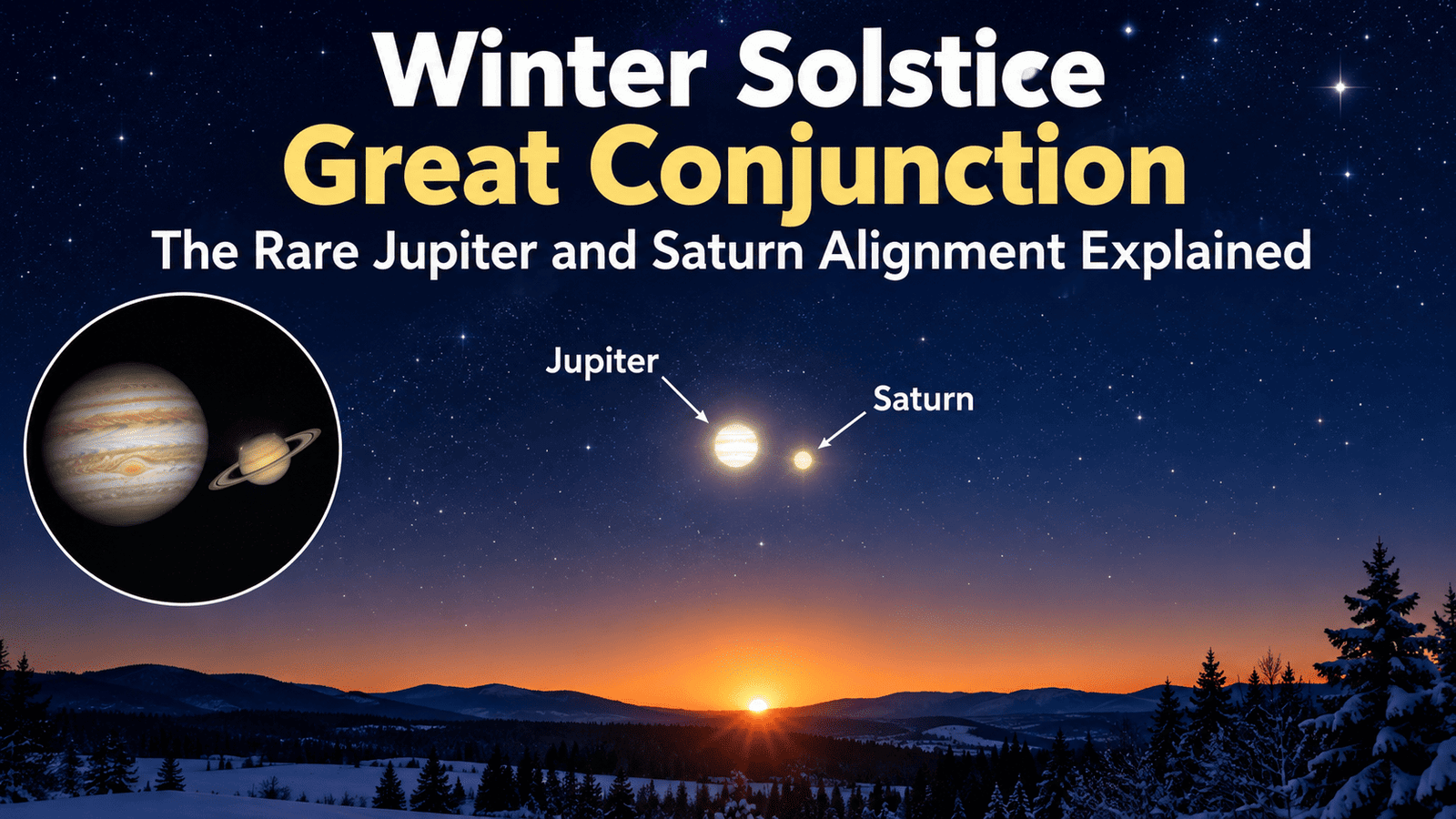
The winter solstice great conjunction became one of the most talked-about astronomical events of December 2020. On December 21, Jupiter and Saturn appeared remarkably close together in the evening sky, creating a rare visual spectacle that skywatchers could observe without expensive astronomical equipment. What made the event particularly special was its timing: the planets reached their closest apparent approach on the same date as the December solstice in the Northern Hemisphere.
Although Jupiter and Saturn appeared almost to merge into a single bright point of light, they remained separated by hundreds of millions of miles. Their unusual appearance resulted from the changing positions of the planets as they travelled around the Sun and from the perspective available to observers on Earth.
The event was not simply another planetary alignment. Their apparent separation was approximately 0.1 degree, making the 2020 conjunction the closest since 1623. An equally close Jupiter–Saturn conjunction is not expected until March 2080, although the planets will experience other great conjunctions before then.
Understanding this event requires looking beyond its striking appearance. The orbital movements of the two giant planets, the meaning of the winter solstice, the historical record of earlier conjunctions, and predictions for future alignments all help explain why December 2020 remains an important moment in modern skywatching.
What Was the Winter Solstice Great Conjunction?
The winter solstice great conjunction was the close apparent alignment of Jupiter and Saturn on December 21, 2020. The planets appeared approximately 0.1 degree apart in Earth’s sky, creating one of the closest and most easily observable great conjunctions in centuries. The event coincided with the December solstice, but the two astronomical occurrences were independent.
The planets did not physically collide or come together in space. Instead, their orbital positions made them appear close from Earth. Great conjunctions occur approximately every 20 years, but the next similarly close alignment is expected on March 15, 2080. The intervening conjunctions, expected in 2040 and 2060, will also be worth observing, although the apparent gap between the planets will be wider.
Winter Solstice Great Conjunction: Key Facts
| Feature | Details |
| Event | Great conjunction of Jupiter and Saturn |
| Date of the 2020 conjunction | December 21, 2020 |
| Closest apparent separation | Approximately 0.1 degree |
| Main planets | Jupiter and Saturn |
| Frequency | Approximately every 20 years |
| Historical significance | Closest conjunction since 1623 |
| Next great conjunction | October 2040 |
| Following conjunction | April 2060 |
| Next similarly close conjunction | March 15, 2080 |
| Common nickname | Christmas Star |
The dates and approximate separation above follow astronomical references from NASA and timeanddate. The date of a conjunction can vary slightly depending on the astronomical definition used and the time zone in which it is reported.
What Makes a Great Conjunction Different From an Ordinary Planetary Alignment?
A great conjunction is an astronomical event in which Jupiter and Saturn appear close together in the sky. The term is specific to these two planets and reflects their distinctive orbital relationship. Both are giant planets, but Jupiter travels around the Sun more quickly than Saturn, allowing it to catch up with the more distant planet at regular intervals.
An ordinary planetary alignment is a broader expression. It can describe several planets appearing along the same general region of the sky, although it does not necessarily mean that every planet is positioned in a perfectly straight line in three-dimensional space.
The distinction matters because the phrase winter solstice great conjunction refers to a particular event involving Jupiter and Saturn, not a meeting of every planet in the solar system. Their 2020 alignment was especially remarkable because the apparent gap between them became exceptionally small.
Most great conjunctions place the planets farther apart than they were in December 2020. Their orbital paths are slightly tilted relative to each other, so Jupiter does not pass Saturn at precisely the same apparent distance every time. As a result, the conjunction cycle repeats, but the visual experience changes from one event to the next.
Why Did Jupiter and Saturn Appear So Close in December 2020?
The explanation begins with the movement of the planets around the Sun. Jupiter completes an orbit in approximately 11.86 Earth years, while Saturn takes about 29.46 years. Because Jupiter moves around the Sun more quickly, it gradually gains ground on Saturn when the planets are viewed from Earth.
As their relative positions change, Jupiter eventually appears to catch up with and pass Saturn. This produces a great conjunction approximately every 19.86 years, commonly rounded to 20 years.
However, the planets’ apparent closeness depends on more than the timing of their orbital cycles. Their orbital paths are not perfectly circular, and they do not follow exactly the same plane. These differences affect the angle from which observers on Earth see the planets.
In 2020, the geometry was particularly favorable for a close apparent meeting. On December 21, Jupiter and Saturn were separated by roughly six arcminutes, equivalent to about one-tenth of a degree. For comparison, the full Moon appears approximately half a degree wide, so the gap between the planets was much smaller than the Moon’s apparent diameter.
This made the pair an exceptional target for amateur astronomers. With suitable viewing conditions, observers could distinguish the two planets with the unaided eye, while a telescope could reveal more detail and allow both planets to be viewed within the same field of view.
The important point is that the planets’ apparent proximity did not represent a sudden change in their physical orbits. It was the predictable result of their regular movement through the solar system.
The Connection Between the Great Conjunction and the Winter Solstice
The conjunction attracted additional attention because it occurred on the December solstice. Although these events happened on the same date, they have different astronomical causes.
What Happens During the Winter Solstice?
The December solstice occurs when Earth’s axial tilt places one hemisphere at its greatest inclination away from the Sun. In the Northern Hemisphere, this produces the shortest daylight period and the longest night of the year. In the Southern Hemisphere, the same event marks the summer solstice and the longest day.
Earth’s axis is tilted by approximately 23.5 degrees relative to the plane of its orbit around the Sun. As Earth travels around the Sun, this tilt changes the distribution of sunlight between the two hemispheres, producing the seasons.
The December solstice usually occurs on December 21 or 22, although the precise date and local calendar time can vary. It is an annual part of Earth’s seasonal cycle rather than a planetary alignment.
Why Did Both Events Occur on December 21?
The great conjunction depended on the relative orbital positions of Jupiter, Saturn, and Earth. The solstice depended on Earth’s orientation relative to the Sun.
The two events therefore followed separate astronomical cycles. Their coincidence on December 21, 2020, made the occasion more memorable, but the solstice did not cause Jupiter and Saturn to align.
This distinction also explains why future great conjunctions will occur on different dates. The next conjunction is expected in October 2040, followed by another in April 2060. Neither date needs to coincide with a solstice for the event to qualify as a great conjunction.
How Rare Was the 2020 Jupiter–Saturn Alignment?
Great conjunctions occur roughly every two decades, so the event itself is not exceptionally rare. The unusual feature of the 2020 conjunction was how closely the planets appeared to pass each other.
According to NASA and timeanddate, the December 2020 conjunction was the closest since July 1623. However, the 1623 event occurred when the planets were relatively close to the Sun in the sky, making it difficult to observe.
For an equally close conjunction with favorable visibility, astronomers must look much further back, to March 1226. That historical comparison is why the 2020 event was widely described as the closest readily observable great conjunction in approximately 800 years.
These comparisons require a little care. The closest mathematical separation, the closest event observable after sunset, and the closest conjunction visible from a particular location are not necessarily the same thing. Weather, daylight, the planets’ position relative to the Sun, and the observer’s location all influence visibility.
The 2020 event combined an exceptionally small angular separation with practical evening viewing opportunities. That combination made it particularly significant for public astronomy.
Could You See the Great Conjunction Without a Telescope?
Yes. One of the most appealing aspects of the 2020 event was that Jupiter and Saturn were bright enough to be seen without specialized equipment. Observers generally needed a clear view of the southwestern horizon shortly after sunset in locations where the planets were visible in that part of the sky.
A telescope was not essential, although it offered a different experience. At such a small apparent separation, both planets could fit within the field of view of many telescopes. Depending on the instrument and observing conditions, viewers could also see Jupiter’s larger moons and Saturn’s rings.
What Made the Best Viewing Conditions?
Three factors played an important role:
An unobstructed horizon: Buildings, trees, hills, and other obstacles can block planets that appear low in the sky. An open viewing location improves the chance of seeing the pair before they set.
Clear weather: Clouds and haze can hide even bright planets. A clear western or southwestern horizon was particularly helpful during the 2020 event.
Correct timing: Jupiter and Saturn were best observed shortly after sunset. Waiting until late at night would not necessarily improve visibility because the planets were setting relatively early.
These recommendations describe the 2020 conjunction. Anyone planning to observe a future planetary meeting should check a current astronomical calendar because the planets’ positions and viewing times change over the years.
How the Great Conjunction Looked Through Binoculars and Telescopes
To the naked eye, Jupiter and Saturn appeared as two bright objects positioned extremely close together. Their brightness made the pair easy to recognize against the evening sky when weather conditions were favorable.
Binoculars offered a wider field of view and could help observers distinguish the planets more clearly. A small telescope provided a closer look, making Jupiter’s disk and its four largest moons potential observing targets. Saturn’s rings could also be visible through suitable equipment.
The exact amount of detail depended on the telescope’s quality, magnification, atmospheric conditions, and the observer’s experience. High magnification is not always beneficial; a sharp, stable image at moderate magnification can reveal more than a heavily magnified but blurry view.
Photographers also used the conjunction as an opportunity to capture the two planets above landscapes and recognizable buildings. Images from the event showed how an astronomical alignment could be documented both as a scientific observation and as a visual record of a rare evening sky.
Why Was the Great Conjunction Called the Christmas Star?
The 2020 alignment took place only a few days before Christmas, and the planets’ combined appearance encouraged many people to call it the Christmas Star or the Bethlehem Star.
The nickname refers to the bright, star-like appearance of Jupiter and Saturn when viewed from Earth. It also reflects comparisons with the Star of Bethlehem described in the biblical Nativity story.
Some historians and astronomers have considered whether an unusual planetary conjunction could help explain the ancient account. However, there is no universally accepted scientific identification of the Star of Bethlehem, and the 2020 event does not establish what the biblical description referred to.
It is therefore useful to distinguish between the established astronomy and the historical interpretation. The positions of Jupiter and Saturn in December 2020 can be calculated precisely. The identity of an object described in an ancient religious text remains a separate question that involves historical evidence and interpretation.
The Christmas Star nickname helped introduce the event to a wider audience, but the astronomical explanation does not depend on any particular religious or historical interpretation.
When Will the Next Great Conjunction Happen?
The next great conjunction after the 2020 event is expected in 2040. Another will occur in 2060, followed by the exceptionally close conjunction of 2080.
These dates are important because they distinguish the regular conjunction cycle from the much rarer occasions when Jupiter and Saturn appear almost merged in the sky.
| Expected date | Significance |
| October 31, 2040 | Next great conjunction after 2020 |
| April 7, 2060 | Following great conjunction |
| March 15, 2080 | Next similarly close conjunction |
| September 18, 2100 | Another great conjunction |
The dates refer to the astronomical conjunctions as listed by timeanddate. Exact local calendar dates and viewing circumstances can depend on the observer’s time zone and location.
Why Is 2080 Especially Important?
The 2080 conjunction is expected to bring Jupiter and Saturn to an apparent separation of approximately 0.1 degree, comparable to their 2020 alignment. The 2040 and 2060 conjunctions will still be worthwhile astronomical events, but the planets are expected to appear approximately 1.1 degrees apart during those encounters.
That difference is substantial from an observing perspective. An angular separation of 1.1 degrees is roughly eleven times the separation seen in 2020, even though the planets will still appear close together against the background of the sky.
This is why saying that the next great conjunction will occur in 2040 is correct, while saying that the next similarly close conjunction will occur in 2080 is also correct. The two statements describe different levels of apparent closeness rather than contradicting each other.
Does a Great Conjunction Affect Earth?
A great conjunction does not create a special physical event on Earth simply because the planets appear close together in the sky. Jupiter and Saturn continue along their regular orbits, and the alignment does not suddenly change Earth’s seasons or disrupt the normal functioning of the solar system.
The planets do exert gravitational forces on other objects, including Earth, as they always do. However, the fact that they appear close from our viewpoint does not mean that they are physically close to each other or that their combined gravitational influence suddenly becomes extraordinary.
There is no established scientific evidence that a Jupiter–Saturn conjunction causes earthquakes, major political events, changes in human behavior, or other extraordinary earthly outcomes. Claims of that kind should not be confused with the well-understood orbital mechanics behind the event.
The genuine importance of the conjunction lies in astronomy, education, and observation. It offers an accessible way to understand planetary motion, compare apparent and actual distances, and encourage people to explore the night sky.
What Can the Winter Solstice Great Conjunction Teach Us About Astronomy?
The event provides several useful lessons about how the solar system works.
First, it demonstrates that the apparent positions of celestial objects depend on the observer’s viewpoint. Two planets can appear close together in the sky while remaining separated by hundreds of millions of miles.
Second, it illustrates how orbital periods create predictable astronomical cycles. Jupiter moves around the Sun more quickly than Saturn, allowing the two planets to appear together at regular intervals.
Third, the event shows that independent astronomical cycles can coincide. The December solstice resulted from Earth’s axial tilt, while the conjunction resulted from the relative positions of the planets. Their shared date was a coincidence rather than a cause-and-effect relationship.
Finally, the event demonstrates why accurate astronomical predictions are valuable. Scientists can calculate planetary positions years in advance, allowing observers to plan for future conjunctions and understand why some alignments are more striking than others.
Frequently Asked Questions
What was the winter solstice great conjunction?
It was the exceptionally close apparent alignment of Jupiter and Saturn on December 21, 2020. The event coincided with the December solstice and was notable because the planets appeared approximately 0.1 degree apart.
Why was the 2020 great conjunction so special?
The planets came closer together in Earth’s sky than they had since 1623. The conjunction was also readily observable in the evening sky under suitable conditions, making it an exceptional public astronomy event.
How often do Jupiter and Saturn have a great conjunction?
The two planets experience a great conjunction approximately every 20 years. The exact apparent separation varies, so some conjunctions look much closer than others.
When is the next great conjunction?
The next great conjunction after 2020 is expected in October 2040, with another in April 2060. The next similarly close Jupiter–Saturn alignment is expected in March 2080.
Did the planets physically meet during the conjunction?
No. Jupiter and Saturn remained hundreds of millions of miles apart. They appeared close because they occupied nearly the same direction in Earth’s sky, not because they physically touched.
Was the conjunction caused by the winter solstice?
No. The conjunction and solstice occurred on the same date by coincidence. The solstice is caused by Earth’s axial tilt, while the conjunction results from the changing orbital positions of Jupiter, Saturn, and Earth.
Could people see the conjunction with the naked eye?
Yes. Both planets were visible without a telescope during the 2020 event, provided the sky was clear and the viewing location offered a suitable horizon. Binoculars and telescopes could reveal additional details.
Final Thoughts
The winter solstice great conjunction of December 2020 was a striking demonstration of the solar system’s predictable but sometimes spectacular motion. Jupiter and Saturn appeared exceptionally close together, creating a rare visual event that observers could enjoy without expensive equipment.
The coincidence with the December solstice added seasonal significance, while the planets’ unusually small apparent separation distinguished the event from more typical great conjunctions. Yet the underlying science remained straightforward: Jupiter and Saturn continued their normal orbits, and their positions made them appear almost united when viewed from Earth.
The next great conjunction is expected in 2040, followed by another in 2060. For observers hoping to see a similarly close alignment, March 2080 is the date to remember. Until then, other planetary conjunctions and changing night-sky events will continue to offer opportunities to observe and understand our solar system.
Ultimately, the lasting value of the 2020 event is not simply that two planets appeared close together. It is that a predictable astronomical phenomenon gave millions of people a reason to look up, ask questions, and discover more about the universe around them.
