
Introduction
Statens Luftfartsvæsen, commonly abbreviated as SLV, was Denmark’s former civil aviation authority. It operated under the Danish transport ministry and was responsible for regulating civil aviation, supervising aviation safety, and establishing the conditions needed for safe and efficient air transport. Although the organization no longer exists as an independent authority, its history remains important for understanding how Denmark developed its system of aviation regulation.
The organization brought together several functions that are essential to civil aviation, including regulatory oversight, technical standards, air traffic services, and the supervision of aviation-related activities. Its work affected airlines, aircraft operators, airports, aviation personnel, and other organizations involved in flying.
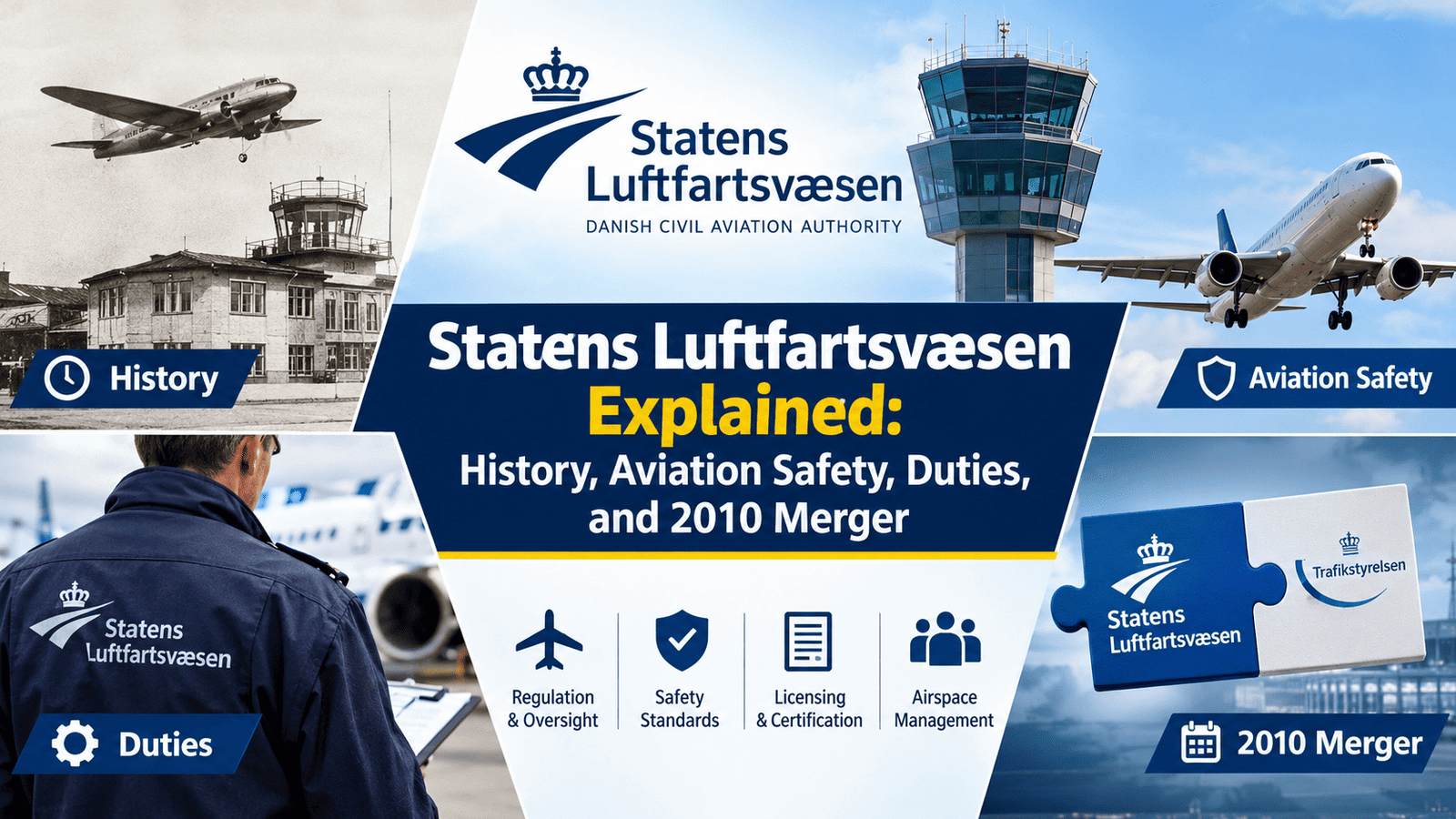
A major turning point came on 1 November 2010, when Statens Luftfartsvæsen merged with Trafikstyrelsen, Denmark’s transport agency. The merger was intended to bring regulatory and supervisory responsibilities across different transport sectors under a more unified administrative structure. <Cite refs={[“turn535873search1″,”turn535873search0”]}/>
Understanding this transition helps explain both the historical significance of Statens Luftfartsvæsen and the institutional framework that subsequently took responsibility for its aviation duties.
What Was Statens Luftfartsvæsen?
Statens Luftfartsvæsen was a Danish government authority responsible for civil aviation regulation and oversight. Its Danish name is commonly translated into English as the Civil Aviation Administration of Denmark. The abbreviation SLV is frequently used in historical documents, regulations, and aviation-related records.
The authority worked to ensure that civil aviation operated according to applicable laws, technical requirements, and safety standards. Its responsibilities extended beyond issuing rules: it also supervised compliance and dealt with the practical regulatory requirements faced by aviation organizations.
Under the rules in force before the 2010 merger, SLV operated under the Ministry of Transport. Its responsibilities included regulating civil aviation, exercising oversight, advising the transport minister and other public authorities on aviation matters, and operating Bornholm Airport. <Cite refs={[“turn535873search8″,”turn535873search14”]}/>
For this reason, Statens Luftfartsvæsen should not be understood simply as an airport operator or an airline. It was a public authority whose work helped establish the legal and operational framework for civil aviation in Denmark.
History of Statens Luftfartsvæsen
The history of Statens Luftfartsvæsen reflects the gradual development of aviation administration in Denmark. As aircraft technology and commercial flying developed, government oversight became increasingly important to ensure that aviation activities followed consistent rules and safety requirements.
Early foundations in Danish aviation administration
Denmark’s national aviation administration dates back to 1 March 1938, when the relevant authority was established as Luftfartsdirektoratet under the Ministry of Public Works. Its institutional predecessors had already been involved in aviation affairs, and the country’s legal framework for aircraft use had developed earlier in the twentieth century.
The creation of a dedicated aviation authority provided a formal administrative structure for overseeing civil aviation. Such a structure was important as flying evolved from a comparatively limited activity into a more complex transport sector involving commercial operators, airports, aircraft maintenance, training, and passenger services. <Cite refs={[“turn535873search1″,”turn535873search2”]}/>
The adoption of the Statens Luftfartsvæsen name
The authority’s name changed over time as its administrative structure evolved. In 1985, Luftfartsdirektoratet became known as Statens Luftfartsvæsen. The name remained associated with Denmark’s civil aviation administration until the organization ceased to exist as an independent authority in 2010.
This period covered significant developments in aviation technology, international cooperation, and the regulation of commercial air transport. The authority’s role was to apply relevant requirements within Denmark and supervise the activities falling under its jurisdiction.
Historical records also identify earlier names, including Direktoratet for Statens Luftfartsvæsen. These changes are useful to understand when researching archived legislation, government records, or older aviation documents, because the same institutional lineage appears under different names across different periods. <Cite refs={[“turn535873search1″,”turn535873search2”]}/>
The 2010 institutional transition
The most important change in the authority’s modern history occurred in 2010. The Danish transport minister announced the merger of Trafikstyrelsen and Statens Luftfartsvæsen on 27 October that year. The merger took effect on 1 November 2010, and the combined authority retained the name Trafikstyrelsen.
The stated objective was to bring regulatory and supervisory functions covering road transport, railways, and aviation together within one agency. The arrangement was also intended to support stronger coordination of the ministry’s international work, including its engagement with the European Union. <Cite refs={[“turn535873search0″,”turn535873search11”]}/>
The change marked the end of Statens Luftfartsvæsen as a separate government authority, but it did not mean that aviation regulation stopped. Instead, the relevant responsibilities were transferred into the new administrative structure.
Main Responsibilities of Statens Luftfartsvæsen
Statens Luftfartsvæsen had several interconnected responsibilities. Together, these functions helped establish the rules under which civil aviation operated and provided oversight of the people, equipment, and organizations involved.
1. Civil aviation regulation
One of the authority’s central duties was to regulate civil aviation in Denmark. This involved developing and issuing requirements governing aircraft, aviation businesses, airport operations, flight activities, and other areas covered by aviation legislation.
The authority published regulations known as Bestemmelser for Civil Luftfart, commonly abbreviated as BL. These provisions addressed different aspects of aviation, including aircraft and equipment, maintenance facilities, aerodromes, flight operations, training, and certain commercial flying activities.
Such rules gave aviation organizations a common regulatory framework. Airlines, maintenance providers, and other operators needed to understand which requirements applied to their activities and how compliance would be assessed. <Cite refs={[“turn535873search1″,”turn535873search8”]}/>
2. Aviation safety oversight
Aviation safety was another core part of SLV’s work. The authority established technical and operational requirements and monitored whether relevant organizations continued to meet them.
Safety oversight can involve reviewing documentation, examining compliance with applicable regulations, and supervising activities that affect the safe operation of aircraft. It also includes ensuring that required standards for maintenance, personnel qualifications, and operating procedures are followed.
An important distinction is that a regulator does not personally perform every safety-related task. Airlines, maintenance organizations, pilots, airports, and other operators have their own responsibilities. The regulator establishes requirements and provides oversight to help ensure that those responsibilities are fulfilled.
SLV’s aviation safety functions were later incorporated into the work of Trafikstyrelsen. <Cite refs={[“turn535873search5″,”turn535873search8”]}/>
3. Aircraft, personnel, and organizational approvals
Civil aviation depends on qualified personnel, properly maintained aircraft, and organizations that meet the relevant requirements. Statens Luftfartsvæsen performed regulatory functions associated with approving and supervising different participants in the aviation sector.
Depending on the activity and the rules involved, this could include requirements relating to aircraft, maintenance facilities, aerodromes, aviation companies, technical installations, and personnel training or certification.
These controls helped establish whether an operator or organization met the applicable conditions to carry out its activities. They also provided a basis for continued supervision rather than treating an initial approval as proof of permanent compliance. <Cite refs={[“turn535873search5″,”turn535873search14”]}/>
4. Air traffic services and technical systems
Statens Luftfartsvæsen also included functions associated with flight safety services. Historical descriptions identify Flyvesikringstjenesten as the part responsible for air traffic control and other air traffic services, alongside the establishment and operation of relevant technical systems and facilities.
These services are distinct from the regulatory role. Air traffic services support the safe and orderly movement of aircraft, while a regulator establishes and supervises the requirements governing aviation activities.
Keeping this distinction clear is important when examining SLV’s history. The authority’s organizational structure brought together responsibilities that served related but different purposes within Denmark’s aviation system. <Cite refs={[“turn535873search1″,”turn535873search4”]}/>
5. Airport operations
SLV’s historical responsibilities also included direct airport operations. Under the applicable rules, the authority operated Bornholm Airport, and historical references also identify Vágar Airport in the Faroe Islands as part of its activities.
This combination of regulatory duties and airport operations is an important part of understanding the organization’s former structure. Aviation authorities can have different institutional arrangements, and their regulatory and operational responsibilities should not automatically be assumed to be identical.
For anyone researching Danish aviation history, the airport-related duties help explain why SLV’s role extended beyond writing regulations and supervising operators. <Cite refs={[“turn535873search1″,”turn535873search8″,”turn535873search14”]}/>
Why Aviation Safety Regulation Matters
Aviation involves many interdependent systems. Aircraft must be maintained according to applicable standards, flight crews must have the required qualifications, operators must follow approved procedures, and airports and aviation services must meet relevant operational requirements.
Aviation regulation provides a structured way to manage these responsibilities. Without clear standards and effective oversight, different operators could interpret essential requirements inconsistently, creating unnecessary risks and uncertainty.
The historical work of Statens Luftfartsvæsen illustrates several important principles of aviation governance:
- Consistent standards: Regulatory requirements establish a common baseline for aviation activities.
- Qualified personnel: Training and certification requirements help ensure that people performing safety-related duties have the necessary qualifications.
- Technical compliance: Aircraft, equipment, and maintenance activities must meet the requirements applicable to them.
- Operational oversight: Regulatory supervision helps determine whether operators continue to meet their obligations.
- International coordination: Aviation rules must work within a broader international environment in which aircraft and airlines frequently operate across borders.
These principles remain relevant to modern civil aviation, even though the institutional arrangements and applicable rules have changed since SLV existed as a separate authority.
Statens Luftfartsvæsen and the 2010 Merger With Trafikstyrelsen
The 2010 merger was more than a name change. It represented an administrative decision to consolidate transport-related regulatory and supervisory functions.
Before the merger, Statens Luftfartsvæsen focused on aviation, while Trafikstyrelsen already carried responsibilities in other transport areas. Combining the organizations created a single agency structure intended to coordinate oversight across road, rail, and air transport.
The Danish parliamentary record confirms that the merger took effect on 1 November 2010 and that the new agency was named Trafikstyrelsen. Official legal material also explains that references to Statens Luftfartsvæsen in the relevant legislation were replaced by references to Trafikstyrelsen because the former authority had ceased to exist independently. <Cite refs={[“turn535873search0″,”turn535873search3”]}/>
What changed after the merger?
The main institutional change was the transfer of aviation responsibilities into Trafikstyrelsen. The aviation regulatory function continued under the new organizational arrangement rather than disappearing with the old name.
For researchers, this distinction is especially useful. A historical document may identify Statens Luftfartsvæsen as the responsible authority, whereas later documents may identify Trafikstyrelsen. The date of a regulation or administrative decision can therefore help establish which agency name was applicable at the time.
The merger also brought aviation oversight into a broader transport administration. However, it would be inaccurate to conclude that combining agencies automatically eliminated every operational distinction between aviation, rail, and road transport. Each sector continued to require its own specialist knowledge, technical standards, and legal framework.
What Authority Replaced Statens Luftfartsvæsen?
Trafikstyrelsen became the institutional successor to Statens Luftfartsvæsen’s aviation responsibilities following the 2010 merger. The agency is associated with Denmark’s national aviation regulatory functions, including implementing applicable aviation rules and supervising compliance.
Its aviation work operates within national legislation and the wider European and international regulatory environment. The Danish Aviation Act provides the basic legal framework for civil aviation, while relevant powers are assigned to the responsible authority through legislation and related regulations. <Cite refs={[“turn535873search4″,”turn535873search13”]}/>
International coordination is important because aviation is not confined to national borders. Aircraft, airlines, and aviation personnel may operate across multiple jurisdictions, so national regulators must work within shared standards and applicable European requirements.
The International Civil Aviation Organization (ICAO) develops international standards and recommended practices. In Europe, the European Union Aviation Safety Agency (EASA) plays a central role in the common aviation safety framework. Denmark’s aviation administration works within the relevant arrangements applicable to the country.
The specific responsibilities of individual agencies can change over time. Anyone seeking a current decision, licence requirement, operational rule, or official procedure should therefore consult the responsible authority’s latest published guidance rather than relying solely on historical descriptions of SLV.
How to Research Historical Statens Luftfartsvæsen Records
Because Statens Luftfartsvæsen no longer operates under its former name, researching it often requires using historical and archival sources. The name alone may not be sufficient to locate every relevant record, particularly when documents were created under earlier organizational titles.
The following sources provide useful starting points:
| Research source | What it can help establish |
| Danish National Archives (Rigsarkivet) | Historical agency names, archival records, and institutional history |
| Lex.dk | An overview of the authority’s history and responsibilities |
| Danish Parliament (Folketinget) | Parliamentary records and documentation concerning the 2010 merger |
| Retsinformation | Historical legislation and regulations issued under the former authority’s name |
| Trafikstyrelsen | Information about the successor authority and Denmark’s aviation regulatory framework |
These sources serve different purposes. An encyclopedia entry can provide a useful overview, but an official legal text is generally more appropriate when verifying the wording of a regulation. Parliamentary documents are particularly useful for understanding the reasoning and timing of administrative changes.
When reviewing older records, check the publication date, the issuing authority, and whether the document has been superseded or marked as historical. This prevents outdated requirements from being mistaken for current rules.
Is Statens Luftfartsvæsen Still Active Today?
No. Statens Luftfartsvæsen ceased to exist as a separate authority on 1 November 2010, when it merged with Trafikstyrelsen. Its former aviation responsibilities were transferred into the successor agency’s administrative structure. <Cite refs={[“turn535873search2″,”turn535873search3”]}/>
The name can still appear in historical legislation, archived documents, older aviation publications, and records concerning aircraft or aviation organizations. Its continued appearance in these sources does not mean that the former authority is still operating independently.
Anyone looking for current Danish aviation regulations or administrative guidance should begin with Trafikstyrelsen and the applicable official legal sources. Historical SLV documents remain useful for understanding earlier requirements, but they should not automatically be treated as statements of current policy.
Frequently Asked Questions
1. What does Statens Luftfartsvæsen mean?
Statens Luftfartsvæsen is the Danish name of a former government authority responsible for civil aviation regulation and oversight. It is commonly associated with the English description Civil Aviation Administration of Denmark.
2. What was the main purpose of Statens Luftfartsvæsen?
Its main purpose was to support safe and properly regulated civil aviation in Denmark. Its responsibilities included aviation rules, safety oversight, technical and operational requirements, and certain airport and air traffic service functions.
3. When was Statens Luftfartsvæsen established?
The relevant Danish aviation administration was established as Luftfartsdirektoratet on 1 March 1938. The name Statens Luftfartsvæsen was adopted in 1985. <Cite refs={[“turn535873search1″,”turn535873search2”]}/>
4. Why did Statens Luftfartsvæsen merge with Trafikstyrelsen?
The merger was intended to consolidate transport-related regulatory and supervisory responsibilities, including aviation, road transport, and railways, within one agency. The new structure also aimed to support coordination of international work. <Cite refs={[“turn535873search0″,”turn535873search11”]}/>
5. On what date did the merger take effect?
The merger took effect on 1 November 2010. From that date, Statens Luftfartsvæsen no longer existed as an independent authority. <Cite refs={[“turn535873search1″,”turn535873search3”]}/>
6. Which organization took over its responsibilities?
Trafikstyrelsen took over the former authority’s aviation responsibilities within the new administrative structure. It is the appropriate starting point for researching Denmark’s current aviation regulatory framework. <Cite refs={[“turn535873search4″,”turn535873search13”]}/>
7. Did Statens Luftfartsvæsen operate airports?
Yes. Historical and legal sources identify Bornholm Airport as an airport operated by the authority. Historical accounts also describe its involvement in operating Vágar Airport in the Faroe Islands. <Cite refs={[“turn535873search1″,”turn535873search8”]}/>
Conclusion
Statens Luftfartsvæsen played an important role in the development and administration of civil aviation in Denmark. From its institutional origins in 1938 to the adoption of its familiar name in 1985, the authority helped establish aviation regulations, supervise safety requirements, and support the operation of the country’s aviation system.
Its history reached a major turning point on 1 November 2010, when it merged with Trafikstyrelsen. This transition ended SLV’s existence as an independent authority but transferred its aviation responsibilities into a broader transport administration.
Understanding Statens Luftfartsvæsen therefore requires looking at both its historical duties and the institutional changes that followed. For historical research, its records remain valuable; for current aviation requirements, the successor authority and up-to-date legal sources provide the more appropriate reference point.
