
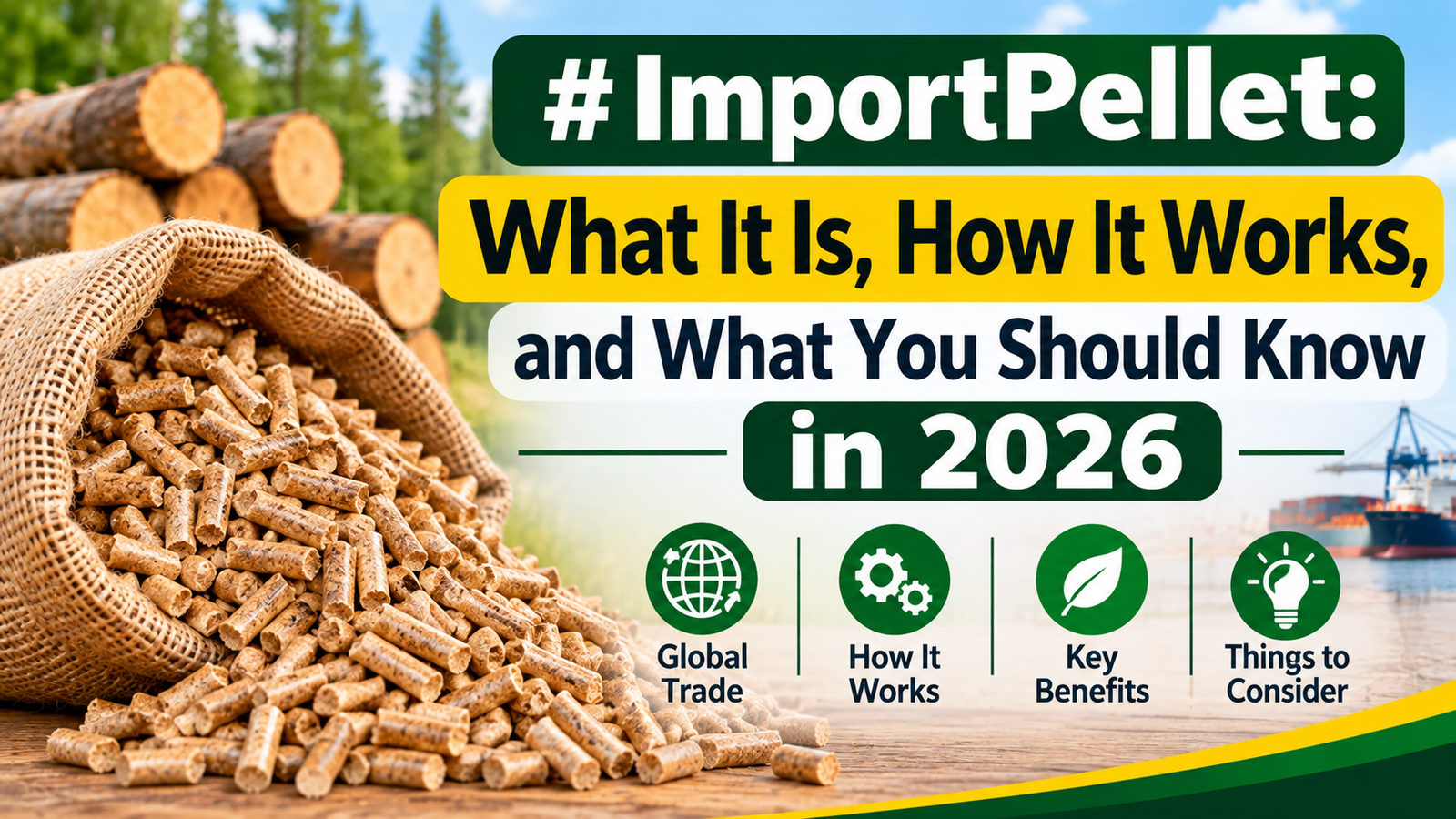
ImportPellet is a term associated with international wood pellet sourcing and importing, particularly in the biomass energy industry. It is also associated with a Brazilian wood pellet sourcing research initiative presented by Mello Commodity. The topic covers supplier discovery, product quality, international shipping, and the commercial considerations involved in importing wood pellets.
Introduction
International trade has made it easier for businesses to purchase raw materials and energy products from different parts of the world. Among these products, wood pellets have become an important commodity for residential heating, commercial facilities, and certain industrial energy applications.
This growing market has also created interest in specialized sourcing information, supplier directories, and international purchasing services. One name appearing in this context is ImportPellet.
People searching for ImportPellet may be trying to understand its purpose, explore its connection with Brazilian wood pellet suppliers, or learn how importing pellet products works. Others may have encountered the name through an online article or business reference.
The important distinction is that ImportPellet should not automatically be treated as a manufacturer, certification organization, or company that physically ships fuel. Its connection with pellet sourcing and supplier research needs to be understood in the correct context.
This guide explains the concept, its relationship with Mello Commodity, the wood pellet market, sourcing considerations, and the factors buyers should examine before making an international purchase.
What Is ImportPellet?
ImportPellet is associated with research and information about sourcing wood pellets from international suppliers, particularly producers and exporters in Brazil.
One specific use of the name is connected with Mello Commodity, which presents information about Brazilian commodity sourcing and international trade.
The ImportPellet concept focuses on helping potential buyers understand the wood pellet market and identify businesses that may be suitable for further investigation.
This type of resource can be useful because finding an overseas supplier is only one part of an import transaction. Buyers also need to understand product specifications, production capacity, quality documentation, transportation arrangements, and commercial conditions.
It is important to distinguish between supplier research and direct purchasing. A guide can help buyers identify potential suppliers, but it does not automatically manufacture, certify, sell, or deliver the products.
Quick Facts About ImportPellet
| Detail | Information |
| Main keyword | ImportPellet |
| Industry | Biomass and international commodity trade |
| Main product association | Wood pellets |
| Related organization | Mello Commodity |
| Country of sourcing interest | Brazil |
| Main purpose | Supplier research and import guidance |
| Common applications | Heating and industrial energy |
| Relevant quality standard | ISO 17225-2 |
| Related certification | ENplus |
| Target audience | Importers, distributors, and energy businesses |
How Is ImportPellet Connected to Mello Commodity?
Mello Commodity is the organization associated with the Brazilian wood pellet sourcing research presented under the ImportPellet name.
Its published material introduces international buyers to potential Brazilian suppliers and provides information about the country’s wood pellet export market.
One of its featured resources is the Brazilian Wood Pellet Suppliers Guide 2026. The guide’s description identifies research covering 17 companies, including producers, exporters, and trading businesses.
The resource is designed to help buyers organize their initial supplier research rather than replace direct negotiations with manufacturers.
This distinction is important because different businesses perform different roles in international trade.
- Producers: Manufacture wood pellets from suitable raw materials.
- Exporters: Arrange and manage the international sale of products.
- Trading companies: Connect buyers with suppliers and facilitate commercial transactions.
- Sourcing researchers: Collect and organize information that helps buyers identify potential business partners.
Understanding these roles makes it easier to evaluate ImportPellet-related information and determine what additional checks are necessary before placing an order.
What Are Wood Pellets?
Wood pellets are small cylindrical fuel products manufactured by compressing processed wood materials into a compact form.
Common raw materials include:
- Sawdust from wood-processing facilities
- Wood shavings
- Suitable forestry residues
- Other qualifying untreated wood materials
The manufacturing process generally involves preparing the raw material, controlling moisture, processing it into a suitable size, and compressing it through specialized equipment.
The resulting pellets are relatively uniform in shape and can be transported in bags or bulk shipments.
Their compact form also makes them suitable for automated fuel-feeding systems.
Wood pellets are commonly used in residential heating equipment, commercial boilers, and selected industrial energy systems. However, the appropriate fuel specification depends on the equipment and intended application.
The international standard ISO 17225-2:2021 establishes fuel quality classes and specifications for graded wood pellets used in non-industrial and industrial applications.
Why Is Brazil Important in the Wood Pellet Market?
Brazil is an important country to examine when researching international biomass sourcing because of its established forestry and wood-processing industries.
These industries generate different types of wood materials that can potentially be used in biomass production, subject to sustainability requirements and manufacturing specifications.
For international buyers, Brazil may offer opportunities to investigate alternative suppliers and develop relationships with exporters outside their existing markets.
There are several reasons businesses may consider Brazilian wood pellet suppliers:
1. Access to Wood-Processing Resources
Wood-processing industries generate materials such as sawdust and wood residues that can be used in suitable pellet manufacturing processes.
2. Supplier Diversification
Importers may benefit from comparing suppliers in different countries instead of depending entirely on one production region.
3. International Trading Opportunities
Businesses can investigate commercial relationships with producers, exporters, and commodity trading companies.
4. Potential Long-Term Supply Arrangements
Companies with consistent fuel requirements may explore contracts with manufacturers capable of meeting their quality and delivery expectations.
However, a country‘s production potential does not guarantee that every supplier offers suitable products, competitive prices, or reliable delivery. Individual businesses must be evaluated independently.
How Does the ImportPellet Sourcing Process Work?
International pellet sourcing involves several stages. ImportPellet-related research can help buyers understand the initial supplier discovery process, but completing an import transaction requires additional commercial and logistical work.
1. Identify the Required Pellet Type
The first step is determining exactly what kind of pellet a business needs.
Wood pellets for household heating may require different specifications from products intended for large industrial boilers.
Buyers should establish their requirements for:
- Pellet diameter and length
- Moisture content
- Ash content
- Mechanical durability
- Calorific value
- Raw material composition
Clear specifications help prevent misunderstandings between buyers and suppliers.
2. Research Potential Suppliers
Once the requirements are established, businesses can identify manufacturers and exporters that may offer suitable products.
This is where a sourcing guide can provide practical value.
Rather than contacting random companies, buyers can begin with an organized list and investigate each supplier’s production capabilities, business history, and export experience.
3. Request Product Samples
Before committing to a substantial shipment, buyers should consider requesting representative product samples.
Samples allow businesses to evaluate physical characteristics and arrange independent laboratory testing where appropriate.
This step can reveal differences between advertised specifications and the actual material being supplied.
4. Verify Certifications and Documentation
Quality documentation is particularly important in the biomass industry.
Importers should request relevant product test reports and verify any certification claims through the organization responsible for issuing the certification.
A supplier’s statement that its products are certified should never be treated as sufficient proof by itself.
5. Compare Commercial Offers
Buyers should request detailed quotations from multiple suppliers.
A useful quotation should explain the product specification, quantity, price, packaging, delivery arrangements, and payment conditions.
Comparing complete offers helps businesses identify the most suitable supplier rather than choosing an option based only on its advertised price.
6. Arrange Transportation and Customs Clearance
After selecting a supplier, the buyer must coordinate shipping and import documentation.
Depending on the destination country and product classification, this may involve commercial invoices, packing lists, transport documents, certificates of origin, and other required paperwork.
Customs duties, taxes, inspections, and import restrictions must be checked under the destination country’s current regulations.
What Quality Standards Should ImportPellet Buyers Understand?
Wood pellet quality can directly influence heating performance, equipment maintenance, storage requirements, and overall purchasing costs.
For this reason, buyers should understand recognized quality standards before negotiating international orders.
ISO 17225-2
ISO 17225-2:2021 is an international standard covering fuel quality classes and specifications for graded wood pellets.
It provides a structured framework for describing pellet characteristics and communicating product requirements between manufacturers, sellers, buyers, and equipment manufacturers.
Its scope includes pellets manufactured from virgin wood, wood-processing by-products and residues, and certain chemically untreated used wood materials.
It is particularly relevant when comparing products intended for different heating and industrial applications.
ENplus Certification
ENplus is an established certification scheme for wood pellets.
It addresses more than the appearance of the finished product. Its requirements cover quality-related factors throughout the supply chain, including production, handling, storage, and delivery.
The scheme includes three main quality classes:
| Quality Class | General Description |
| ENplus A1 | Higher-quality pellets, commonly used for domestic heating |
| ENplus A2 | Pellets with different permitted quality characteristics |
| ENplus B | A class associated with specified commercial and industrial applications |
Buyers should verify the certification number and the identity of the certified producer or trader through official certification records.
Importantly, ENplus certification is not automatically required for every international pellet transaction. The applicable requirements depend on the buyer, market, contract, and destination regulations.
What Are the Main Benefits of Using ImportPellet Research?
Supplier research can make international purchasing more organized, particularly for companies entering an unfamiliar market.
The value comes from improving the quality of the information available before negotiations begin.
Better Supplier Discovery
Finding potential manufacturers in another country can take considerable time.
A structured research resource can help buyers develop an initial list of businesses to investigate.
More Informed Purchasing Decisions
Importers need more than a supplier’s telephone number or email address.
They need information about product specifications, manufacturing capabilities, export experience, and relevant documentation.
Organized research can help buyers prepare better questions before approaching potential business partners.
Reduced Research Time
International sourcing involves reviewing company websites, checking business information, comparing product specifications, and understanding market conditions.
A focused guide may reduce the time spent collecting this initial information.
Improved Supplier Comparisons
When buyers investigate several companies using consistent criteria, it becomes easier to identify differences in product quality, production capacity, commercial terms, and delivery arrangements.
Better Preparation for Negotiations
A buyer who understands the product and its specifications is generally better prepared to discuss prices, quality requirements, inspection arrangements, and delivery conditions.
Nevertheless, research cannot eliminate commercial risk. Every supplier still needs independent verification.
What Challenges Should Buyers Consider Before Importing Wood Pellets?
Although international pellet sourcing offers opportunities, it also involves challenges that can affect the success of a transaction.
Transportation Costs
Wood pellets must be transported from the manufacturing location to the buyer’s destination.
Freight charges, port handling, inland transportation, and storage can significantly affect the final purchasing cost.
Product Quality Differences
Not every manufacturer produces pellets with identical characteristics.
Differences in moisture, ash content, durability, and calorific value can affect product suitability.
Supplier Reliability
A company may have an attractive website and competitive quotation without having the production capacity or export experience required for a large order.
Customs and Import Regulations
Every destination country has its own customs procedures, documentation requirements, and applicable taxes.
Importers should confirm the correct tariff classification and current regulations before arranging a shipment.
Currency and Market Fluctuations
International transactions may involve currency exchange risks and changing transportation or commodity prices.
These factors should be considered when calculating long-term supply costs.
How to Calculate the Real Cost of Importing Wood Pellets
One of the most important considerations for an importer is the total landed cost.
The factory price alone does not show how much a shipment will actually cost once it reaches its destination.
A basic calculation should include:
| Cost Component | What It Covers |
| Product price | Cost charged by the manufacturer or seller |
| Inland transportation | Movement from the production site to the port |
| Export handling | Relevant export and port charges |
| International freight | Shipping to the destination |
| Insurance | Applicable shipment insurance |
| Customs duties | Import duties under local regulations |
| Taxes | Applicable destination-country taxes |
| Port handling | Unloading and related charges |
| Final delivery | Transportation to the buyer’s facility |
Example:
Suppose a company purchases 1,000 tonnes of wood pellets.
- Product purchase: $150,000
- Transportation and handling: $15,000
- International freight: $25,000
- Insurance and documentation: $3,000
- Other import-related costs: $7,000
Total estimated cost: $200,000.
The estimated landed cost is therefore $200 per tonne.
These figures are illustrative only and do not represent actual ImportPellet quotations or current market prices.
This calculation demonstrates why importers should compare total delivered costs instead of selecting suppliers solely on the basis of their factory prices.
Is ImportPellet Suitable for Businesses and International Buyers?
ImportPellet-related sourcing research may be relevant to several types of businesses.
Energy companies: Organizations using biomass fuel may investigate additional sources of wood pellets to support their energy operations.
Import and export businesses: Trading companies can use supplier research to explore potential international commercial relationships.
Wholesale distributors: Distributors may investigate manufacturers that can provide consistent quantities and suitable product specifications.
Industrial facilities: Businesses operating compatible boilers or energy systems may research alternative fuel suppliers.
New market entrants: Entrepreneurs interested in biomass trading can use industry information to understand supplier discovery and import requirements.
However, suitability depends on the quality and accuracy of the research, the buyer’s requirements, and the ability to independently verify potential suppliers.
How to Verify an ImportPellet-Related Supplier Before Making a Purchase
Supplier verification should be treated as an essential part of international trade, not an optional administrative task.
Before making a payment or signing a contract, buyers should examine the following areas:
- Business registration: Confirm the supplier’s legal business identity and registration details where applicable.
- Physical operations: Determine whether the company operates a manufacturing facility, acts as an exporter, or works as an intermediary.
- Product specifications: Obtain a written technical specification for the exact product being offered.
- Certification: Verify claimed quality certifications through the relevant certification organization.
- Laboratory testing: Request recent test reports and consider independent testing.
- Production capacity: Establish whether the company can supply the required quantity consistently.
- Export experience: Request evidence of relevant international trading experience.
- Payment arrangements: Review the proposed payment method and ensure that the beneficiary matches the verified contracting business.
- Inspection procedures: Agree on how product quality and quantity will be checked before shipment.
- Written agreement: Document specifications, delivery terms, responsibilities, and procedures for resolving disputes.
A professional sourcing process should make these checks easier to organize. It should never encourage buyers to skip them.
Is ImportPellet a Reliable Resource?
Reliability depends on the particular resource, the information it provides, and how independently its claims can be verified.
The ImportPellet name is associated with Mello Commodity’s Brazilian wood pellet sourcing research. Its published guide describes research covering 17 companies and provides information intended to help international buyers investigate potential suppliers.
However, buyers should understand three important points:
- A supplier research guide is not a guarantee that every listed company is currently operating or accepting orders.
- Inclusion in a research guide does not automatically mean a supplier is independently certified.
- The existence of a sourcing resource does not guarantee successful delivery, product quality, or commercial profitability.
The safest approach is to treat ImportPellet as a starting point for research and conduct independent checks before making purchasing decisions.
ImportPellet and the Future of Biomass Energy
Biomass energy continues to attract attention from businesses exploring alternatives to conventional fossil fuels.
Wood pellets are one part of this wider industry because they offer a standardized form of solid biomass fuel that can be used in compatible heating and energy-generation equipment.
International sourcing may become particularly relevant to businesses seeking diversified supply arrangements.
However, the future of the wood pellet industry will depend on several factors:
- Availability of responsibly sourced raw materials.
- Improvements in manufacturing efficiency.
- International transportation costs.
- Environmental regulations and sustainability requirements.
- Demand from residential and industrial energy users.
- Greater attention to independently verified product quality.
ImportPellet-related research fits into this wider commercial environment by addressing the information buyers need when exploring international suppliers.
Nevertheless, biomass should not automatically be considered carbon-neutral. Its environmental impact depends on forestry practices, raw material sourcing, manufacturing energy, transportation, and how the fuel is ultimately used.
A responsible purchasing decision should consider the entire supply chain rather than focusing only on the renewable label.
Final Thoughts on ImportPellet
ImportPellet is a relevant name in the context of wood pellet sourcing and international commodity research. Its association with Mello Commodity and the Brazilian Wood Pellet Suppliers Guide 2026 makes it particularly interesting to businesses investigating Brazilian producers, exporters, and trading companies.
Its potential value lies in organizing supplier information and helping international buyers understand the early stages of the sourcing process.
However, successful importing requires much more than finding a supplier. Product specifications, quality certifications, independent verification, transportation arrangements, customs requirements, and total landed costs all influence the outcome.
For businesses exploring the biomass market, ImportPellet can be a starting point for understanding supplier research. The final purchasing decision should always be based on verified information, suitable products, and carefully evaluated commercial terms.
Frequently Asked Questions About ImportPellet
1. What is ImportPellet?
ImportPellet is a name associated with wood pellet sourcing, international importing information, and supplier research. It is also used by Mello Commodity for its Brazilian wood pellet sourcing research.
2. Is ImportPellet a company?
The name is associated with a sourcing research initiative presented by Mello Commodity. It should not automatically be considered a separate wood pellet manufacturer or direct fuel supplier.
3. What is the connection between ImportPellet and Mello Commodity?
Mello Commodity publishes ImportPellet-related information and a Brazilian Wood Pellet Suppliers Guide 2026. The resource is intended to help international buyers research potential suppliers.
4. What products are associated with ImportPellet?
The primary product category is wood pellets, which are compressed biomass materials commonly used for heating and energy generation.
5. Why are Brazilian wood pellet suppliers important?
Brazil is a market worth investigating because of its forestry and wood-processing industries. International buyers may explore Brazilian manufacturers and exporters as part of a diversified sourcing strategy.
6. Does ImportPellet sell wood pellets directly?
Its published sourcing material presents it primarily as a research and information resource. Buyers should contact individual manufacturers or exporters to discuss actual product availability and purchasing arrangements.
7. What is the Brazilian Wood Pellet Suppliers Guide 2026?
It is a supplier research resource published by Mello Commodity. Its description identifies 17 researched Brazilian companies, including producers, exporters, and trading businesses.
