
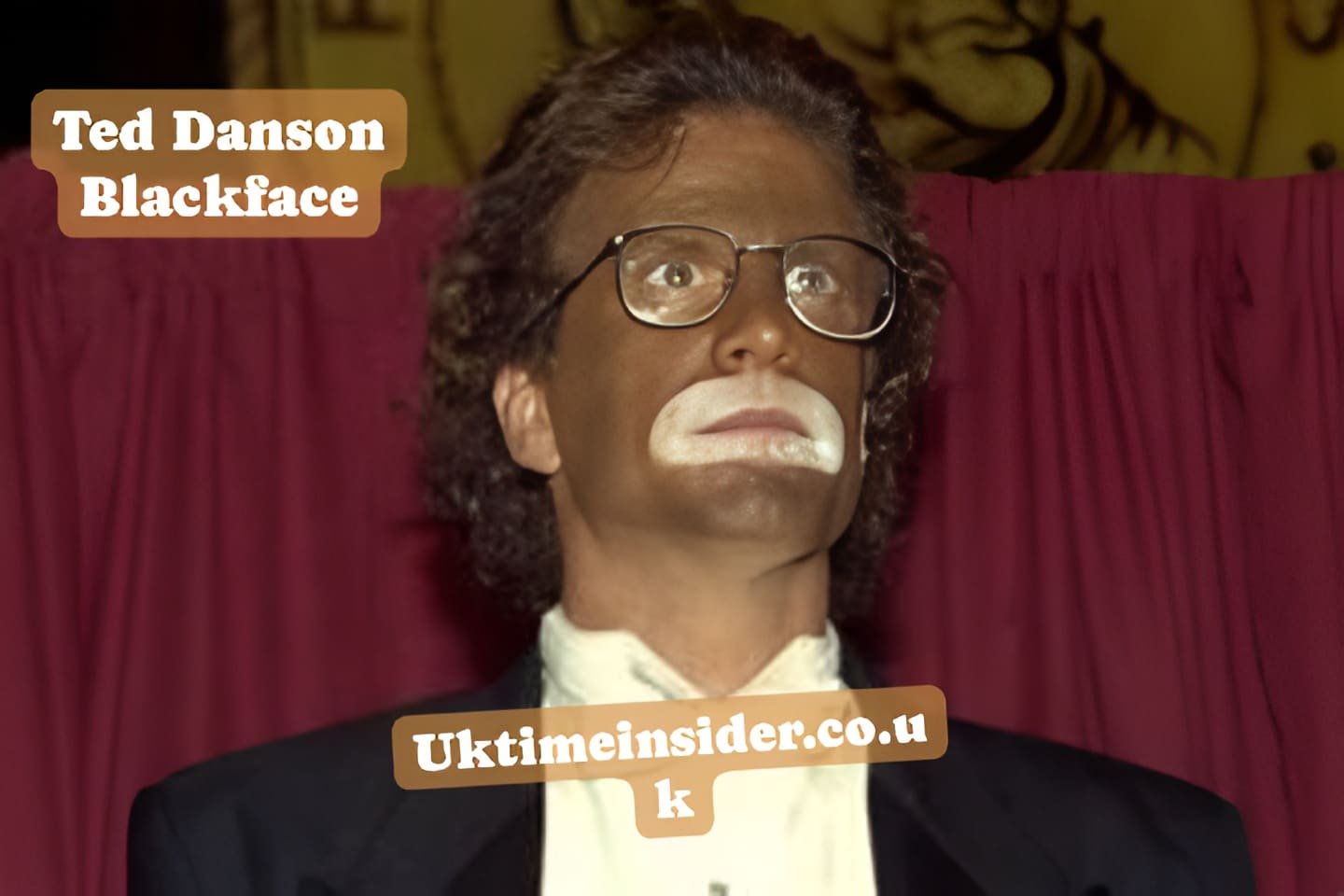
On October 8, 1993, actor Ted Danson appeared in blackface at the Friar’s Club roast honoring his then-girlfriend Whoopi Goldberg in New York City. Danson wore exaggerated minstrel makeup, used racially offensive language repeatedly, and made crude jokes that shocked over 3,000 attendees. Goldberg defended the performance, claiming she helped write the material. The incident became one of the most notorious racial controversies in Hollywood history and nearly derailed Danson’s career.
Ted Danson, best known for his Emmy-winning role as Sam Malone on NBC’s beloved sitcom Cheers, became the center of one of America’s most debated racial controversies in October 1993. At a Friar’s Club charity roast honoring Whoopi Goldberg — his girlfriend at the time — Danson appeared on stage in full blackface makeup with exaggerated white lips, used the N-word over a dozen times, and delivered a set filled with racially charged material that left the audience of 3,000 people stunned. While Goldberg publicly defended the act and even claimed authorship of the material, the scandal triggered a national conversation about race, comedy, intent versus impact, and the unwritten boundaries of humor. This article explores the full story — who Ted Danson is, what happened that night, how the world reacted, and why this moment remains a defining chapter in the complex history of race and entertainment in America.
Quick Bio: Ted Danson
| Full Name | Edward Bridge Danson III |
| Born | December 29, 1947, San Diego, California, USA |
| Age (2026) | 78 years old |
| Nationality | American |
| Profession | Actor, Producer, Environmental Activist |
| Famous For | Sam Malone on NBC’s Cheers (1982–1993) |
| Net Worth | Approximately $80 million |
| Spouse | Mary Steenburgen (married 1995) |
| Education | Carnegie Mellon University, B.F.A. in Drama (1972) |
| Awards | 2x Emmy Awards, 3x Golden Globe Awards, 2025 Carol Burnett Award |
| Controversial Incident | Blackface performance at Friars Club Roast, October 8, 1993 |
Introducing Who Is Ted Danson?
From Arizona Boy to Hollywood Icon
Ted Danson, born Edward Bridge Danson III on December 29, 1947, in San Diego, California, grew up in Flagstaff, Arizona, where his father worked as an archaeologist and director of the Museum of Northern Arizona. From an early age, Danson was surrounded by intellectual energy and a love for the natural world. He attended Stanford University before transferring to Carnegie Mellon University in Pittsburgh, where he earned his Bachelor of Fine Arts in Drama in 1972. His beginnings were humble, starting as an understudy in off-Broadway productions and grinding through commercial work before landing anything notable on screen.
The Making of Sam Malone — A Star Is Born
Danson’s breakthrough came in 1982 when he was cast as Sam Malone, the charming, womanizing ex-baseball-player-turned-bartender on NBC’s Cheers. The show famously ranked last in its debut season but gradually climbed to become one of the most-watched programs in American television history. By the mid-1980s, Danson was a household name, and by the final seasons of Cheers, he was the highest-paid actor on television, earning $450,000 per episode — equivalent to roughly $25 million per season in today’s money. The series finale in May 1993 was watched by 80 million people, making it the second most-watched finale in TV history at the time.
A Career Beyond Cheers — Awards, Range, and Reinvention
After Cheers ended in 1993, Danson refused to be boxed in by his Sam Malone persona. He tackled drama in Damages, earned fresh acclaim in The Good Place as the demon-architect Michael, and earned Emmy nominations that spanned four separate decades. He won two Primetime Emmy Awards, three Golden Globe Awards, and in 2025, received the prestigious Carol Burnett Award for his contributions to television comedy. His estimated net worth stands at approximately $80 million, a testament to one of the most durable careers in the history of American entertainment.
The Night Everything Changed: October 8, 1993
The Friar’s Club Roast — What Was This Event?
The Friar’s Club is one of America’s oldest show business organizations, founded in New York City in 1904. Its celebrity roasts, held behind closed doors, were legendary for their no-holds-barred humor — a tradition where nothing, in theory, was off the table. On October 8, 1993, the ballroom of the New York Hilton Hotel filled with more than 3,000 guests who had each paid $250 a ticket for a charity benefit roast in honor of comedian and actress Whoopi Goldberg. The event was closed to the press, though photographers were present. No cameras were supposed to record the proceedings, and no official footage has ever been publicly released.
Ted Danson Takes the Stage in Blackface
As roastmaster that evening, Ted Danson — then in the midst of a high-profile romantic relationship with Goldberg — took the stage wearing full blackface makeup: his face painted dark brown with an exaggerated white stripe around his mouth in classic minstrel fashion. He also wore a tuxedo and top hat, deliberately evoking the imagery of minstrel-show performers from America’s deeply racist past. What followed was a monologue that included using a racial slur over a dozen times, making explicit jokes about his sex life with Goldberg, jokes about racially mixed children, suggesting Goldberg clean his parents’ house, and at one point — biting into a piece of watermelon. The audience response moved rapidly from uncomfortable laughter to groaning silence.
Also read this: Emily Ruth Black: The Remarkable Woman Behind the Kennedy Legacy Story
The Room Turns — Walkouts and Disbelief
Among the more than 3,000 guests, the reaction was visceral and immediate for many prominent Black attendees. Talk show host Montel Williams walked out just seven minutes into Danson’s set. In a telegram announcing his resignation from the Friar’s Club, Williams wrote that he was confused as to whether he was at a Friar’s Club event or a hate rally. Williams, whose wife is white and had recently given birth to their child, was particularly wounded by jokes about racially mixed children. New York City’s first Black mayor, David Dinkins, who was also in attendance, registered visible discomfort. The atmosphere in the grand ballroom shifted from festive to deeply unsettled in real time.
Whoopi Goldberg’s Defense and the Backlash That Followed
Goldberg Said She Wrote the Material
In what became almost as controversial as the performance itself, Whoopi Goldberg publicly defended Danson in the immediate aftermath. Seated beside him during the roast, she had smiled and laughed throughout. Afterward, she told reporters that she had helped write much of the material and that the entire routine was a direct response to the hate mail the interracial couple had been receiving. She framed the performance as an act of satirical courage, arguing that it took bravery for a white man to appear in blackface in front of 3,000 people to make a point about racial absurdity. She went further, criticizing those who condemned Danson, calling their objections out of touch with the roast tradition.
The Media Storm and National Debate
The incident rapidly escaped the confines of the Hilton ballroom and exploded into a national media controversy. The New York Times called it a flashpoint for a national debate about the First Amendment, political correctness, and interracial relationships. Newspapers across the country ran think pieces and op-eds wrestling with where comedy’s boundaries should lie. Bill Maher, then hosting Politically Incorrect on Comedy Central, defended Danson by arguing that provoking the audience was the very purpose of a Friar’s roast. Others were far less sympathetic — pointing out that blackface carries centuries of painful historical weight that no comedic context can simply erase.
Danson’s Apology and the Couple’s Breakup
Ted Danson did eventually issue a statement saying he had not intended to appear racist. However, a full, publicly articulated apology came later — most notably in a 2009 interview on NPR’s Fresh Air, where Danson described the night as a graceless moment in my life. The couple’s relationship did not survive the scandal: they broke up less than a month after the roast. In the years that followed, Danson rarely spoke about the incident, though he did not deny the pain it caused. The absence of a videotape — which many sources believe existed but was suppressed by publicists — has kept the full performance a piece of largely undocumented history.
The Historical Weight of Blackface in American Culture
Why Blackface Is Never Just Makeup
To understand why the Ted Danson blackface incident caused such profound outrage, one must understand the deep and painful history of blackface in America. Blackface performance originated in the early 19th century as a form of racist theatrical entertainment, in which white performers darkened their skin to portray Black people as buffoons, criminals, or childlike subordinates. These minstrel shows were extraordinarily popular through the 19th and early 20th centuries and served to codify and normalize racist stereotypes in American popular culture. Films like Birth of a Nation (1915) carried these dehumanizing images into cinema. By the 1990s, blackface was widely understood — particularly within Black communities — as a deeply hurtful symbol of systemic racism.
The 1990s Political Correctness Debate
The Danson incident landed in the middle of a fierce cultural battle in early 1990s America over what was then called political correctness. Conservative commentators argued that censoring offensive humor was a form of oppression; progressive voices countered that marginalized communities deserved protection from rhetoric rooted in their historical dehumanization. This tension gave the story a life far beyond celebrity gossip — it became a referendum on whose comfort mattered more in a supposedly pluralistic society. The fact that Goldberg, a Black woman, defended the performance added layers of complexity that commentators struggled to navigate, because it seemed to complicate the simple narrative of a white man offending Black people.
Intent Versus Impact — A Lesson That Endures
Perhaps the most important principle that the Ted Danson blackface incident crystallized for popular discourse was the distinction between intent and impact. Danson’s supporters — including Goldberg — argued that because the intent was satirical and the context was comedic, the material should be judged differently. Critics countered that the historical associations of blackface do not dissolve based on the intentions of whoever is wearing the makeup. The pain experienced by Montel Williams, David Dinkins, and countless others watching or reading about the performance was real and legitimate, regardless of what Danson meant to communicate. This remains one of the most instructive case studies in modern discussions of race and humor.
The Aftermath: How the Scandal Shaped Danson’s Career and Legacy
A Career That Survived — But Was Never Quite the Same
In the immediate aftermath of the roast, Danson’s career was genuinely in jeopardy. The backlash was severe and sustained. Yet within a few years, Danson managed to rebuild his reputation through consistent, quality work. His subsequent roles in Becker, Damages, The Good Place, and CSI allowed audiences to gradually separate the actor from the incident. His marriage to actress Mary Steenburgen in 1995 — a relationship that has endured to this day — also helped rehabilitate his public image. By the 2010s, Danson had effectively transformed from a scandal-tainted figure into a beloved elder statesman of American television.
Goldberg’s Own Career and the Lasting Questions
Whoopi Goldberg’s role in the affair also had long-term implications for her public image. Her defense of Danson struck many observers as deeply misguided, and her willingness to claim ownership of the material only deepened the confusion. Over the following decades, Goldberg would find herself embroiled in other race-related controversies — most notably her 2022 comments on The View about the Holocaust — which reignited discussions about her judgment on matters of racial harm. Critics have long pointed out that the ability to laugh at racist imagery is not equally distributed across racial lines, and that even a Black woman writing the material does not neutralize the harm of a white man performing it in blackface.
Why the Incident Still Matters in 2026
More than three decades after the event, the Ted Danson blackface controversy remains remarkably relevant. In an era of renewed scrutiny over racial representation, the power of symbols, and the accountability of public figures, the 1993 Friar’s Club roast continues to be cited as a defining example of how easily entertainment can stumble into cultural harm — and how complex the aftermath can be. Scholars, journalists, and students of media continue to examine the incident to understand questions of race, intent, comedy, and accountability. The fact that no video has ever surfaced only adds to the incident’s mystique and longevity as a cultural touchstone.
Conclusion
The story of Ted Danson and blackface is not a simple one. It is not merely the story of a white man making a catastrophically poor decision in front of 3,000 people. It is a story about the complicated intersection of love, comedy, race, history, celebrity, and accountability. It is a story about how even the most well-intentioned acts can cause profound harm when stripped of context — or when the context itself is rooted in centuries of pain. Ted Danson went on to have a remarkable career, and by most accounts has genuinely reckoned with what happened that night in October 1993. But the incident deserves to be understood fully and honestly — not to condemn a person permanently, but to learn from a moment that exposed real fault lines in American culture. The lesson of the 1993 Friar’s Club roast is not that comedy cannot address race. It is that the history we carry into a room matters — and that acknowledging that history is not political correctness. It is basic human respect.
Frequently Asked Questions (FAQs)
1. What exactly did Ted Danson do at the Friar’s Club roast?
Ted Danson appeared in full blackface makeup at the October 1993 Friar’s Club roast honoring Whoopi Goldberg. He used a racial slur over a dozen times, made crude jokes about his interracial relationship, and at one point ate watermelon on stage, evoking minstrel-era stereotypes. The performance appalled many in the audience of over 3,000 people.
2. Did Whoopi Goldberg defend Ted Danson’s blackface performance?
Yes. Whoopi Goldberg publicly defended Danson and even claimed she helped write much of the material. She argued that the Friar’s Club roast tradition demanded edgy, boundary-pushing humor and criticized those who condemned the performance as misunderstanding the comedic context. Her defense itself became a significant point of controversy.
3. Did Ted Danson ever apologize for the blackface incident?
Yes, though his apology came gradually. Danson issued an initial statement saying he had not intended to appear racist. In a 2009 NPR Fresh Air interview, he described the night as a graceless moment in his life. He has since rarely discussed it publicly but has acknowledged that the performance was deeply misguided.
4. Was there any video recorded of Ted Danson’s blackface performance?
No official video has ever been made public. While some sources believe footage exists — possibly recorded via closed-circuit cameras — it has never surfaced online or through media coverage. Many believe Danson’s publicists suppressed any recording to protect his career. Only a few photographs from the event have ever been published.
5. How did the blackface incident affect Ted Danson’s career?
The incident severely damaged Danson’s reputation in the immediate term and nearly derailed his post-Cheers career. However, he gradually rebuilt his image through subsequent quality roles in Becker, The Good Place, and CSI. By the 2010s, he had largely recovered and is now regarded as one of television’s most respected long-term performers.
6. Who walked out of Ted Danson’s performance at the roast?
Talk show host Montel Williams walked out approximately seven minutes into Danson’s set and subsequently resigned from the Friar’s Club in protest. Williams, who was married to a white woman and had a mixed-race child, was particularly hurt by jokes Danson made about interracial children. New York City Mayor David Dinkins also registered visible discomfort.
7. Why is blackface considered so offensive?
Blackface originates from 19th-century American minstrel shows, where white performers darkened their faces to mock and dehumanize Black people. These performances reinforced racist stereotypes for over a century and caused lasting cultural harm. By the 1990s — and certainly today — blackface is widely recognized as a deeply painful symbol of racism, regardless of the context or intent of the person wearing it.
Fore more info: Uktimeinsider.co.uk
