
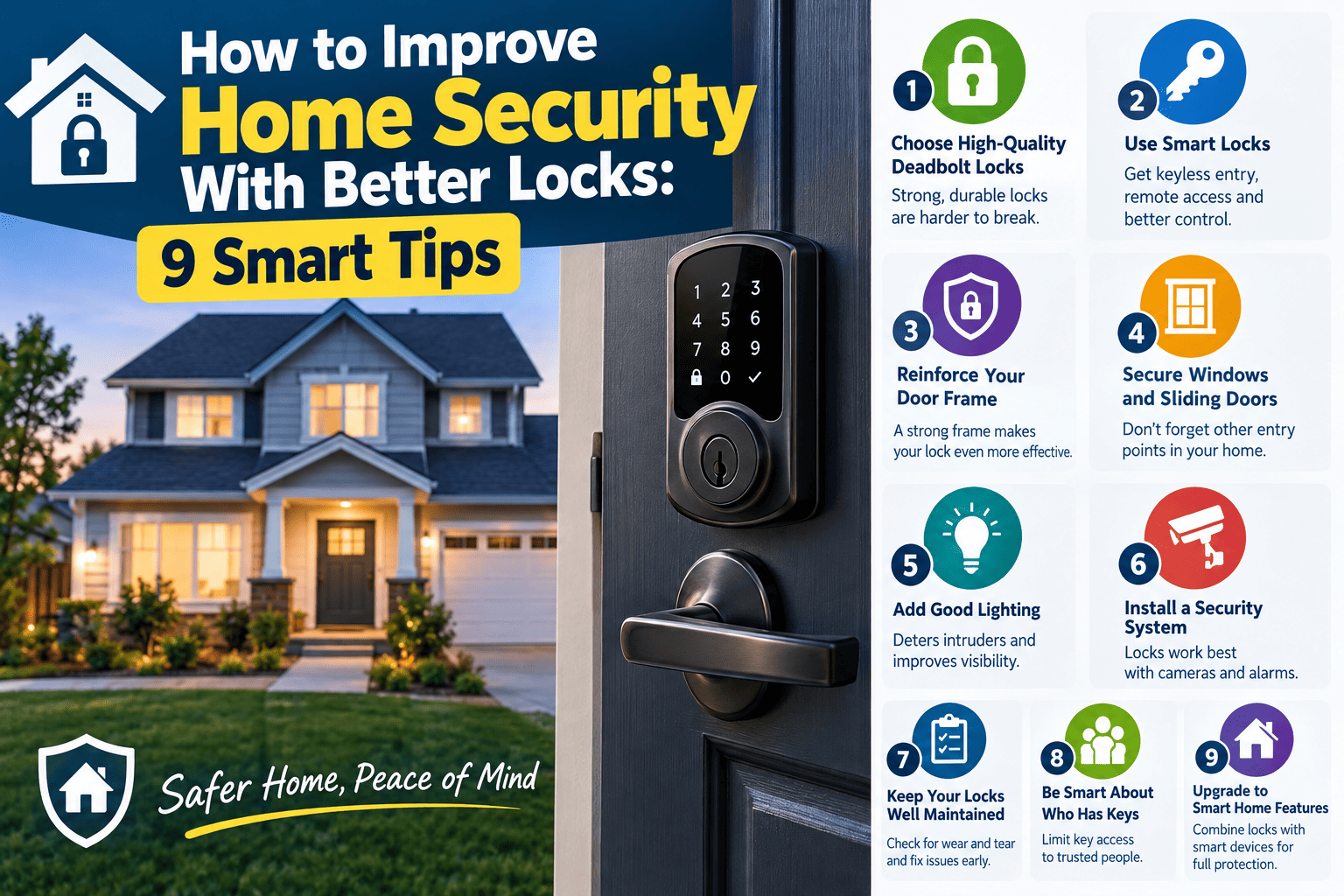
You can improve home security with better locks by installing quality deadbolts on exterior doors, reinforcing strike plates, upgrading weak door hardware, securing sliding doors, and replacing or rekeying locks when keys are lost. Choose locks suited to your door and security needs, and ensure they are professionally installed when necessary. Combining strong locks with secure doors, good lighting, and careful key management provides better overall protection.
Introduction
Your home should be a place where you feel comfortable, relaxed, and protected. However, an old lock, a weak door frame, or an easily misplaced key can create unnecessary security concerns. Many homeowners focus on alarms and cameras without first checking whether their doors and locks provide a reliable first line of defense.
The good news is that improving home security does not always require an expensive renovation. Replacing outdated locks, strengthening door frames, and adopting a few simple security habits can make your home more difficult to enter without permission.
Understanding how to improve home security with better locks starts with choosing suitable hardware and making sure every important entry point is properly secured.
In this guide, you will discover nine practical tips to help protect your home, reduce common security weaknesses, and choose locking systems that suit your property and budget.
Why Better Locks Matter for Home Security
Locks play an important role in controlling access to your home. However, not all locks offer the same level of protection. A basic lock may be convenient for everyday use, but an exterior door often needs stronger hardware and a properly reinforced frame.
A secure entry point depends on several components working together, including the lock, bolt, strike plate, door material, frame, and hinges. If one component is weak, it can reduce the effectiveness of the entire setup.
Better locks can help you:
- Reduce the risk of unauthorized entry.
- Improve protection for exterior doors.
- Control who has keys to your property.
- Secure garages, gates, and secondary entrances.
- Manage access more conveniently with suitable smart locks.
- Feel more confident when leaving home unattended.
Remember that no lock is completely burglar-proof. The goal is to create multiple layers of protection that make unauthorized access more difficult.
1. Install High-Quality Deadbolt Locks
One of the most effective ways to improve exterior door security is to install a suitable deadbolt. Unlike a typical spring latch, a deadbolt uses a solid bolt that extends into the door frame when locked.
This design provides an additional layer of protection when the door, lock, and frame are properly installed.
What should you look for in a deadbolt?
Choose a deadbolt that fits your door’s thickness and construction. Look for durable materials, reliable internal components, and independent security testing or certification recognized in your region.
For many conventional hinged exterior doors, a deadbolt with approximately a one-inch (25 mm) bolt throw is a common security recommendation. However, the correct specification depends on the door and the applicable installation requirements.
A single-cylinder deadbolt is operated with a key from outside and a thumb turn from inside. This arrangement is convenient for everyday use, but the surrounding door design matters, especially if glass panels are nearby.
Avoid choosing a lock based on appearance or price alone. A quality product that is correctly installed is generally a better investment than an impressive-looking lock fitted poorly.
Practical tip: Inspect your main entrance, back door, and other exterior hinged doors. If any rely only on a basic handle lock, consider whether an appropriate deadbolt would improve their security.
2. Reinforce the Door Frame and Strike Plate
A strong lock cannot provide its intended protection if the door frame is weak. The strike plate is the metal fitting attached to the frame that receives the bolt when the door is locked.
If the plate is flimsy or secured poorly, the surrounding wood may split under force. This is why reinforcing the area around the lock is just as important as choosing a better locking mechanism.
How can you strengthen the strike area?
Consider these improvements:
- Replace a thin strike plate with a suitable heavy-duty model.
- Use the manufacturer’s recommended fasteners.
- Where appropriate, secure the plate into the structural framing behind the door jamb.
- Repair cracked, loose, or deteriorating door frames.
- Have a professional inspect the frame if the door moves excessively or the locking area appears damaged.
Longer screws, often around three inches where suitable, are commonly recommended for improving the connection between a strike plate and structural framing. However, the correct screw length and type depend on the door assembly and surrounding materials.
Do not assume that installing a larger plate alone will solve every weakness. The complete frame must be sound, and the lock bolt must align correctly with its opening.
This upgrade is especially worth considering for older homes with worn wooden frames.
3. Replace Old, Worn, or Outdated Locks
Locks experience wear over time. Keys can become difficult to turn, cylinders may loosen, and internal parts can deteriorate after years of use.
A lock that sticks repeatedly or fails to engage fully should not be ignored. It may leave your door difficult to secure when you need it most.
Check your exterior locks for these warning signs:
- The key frequently jams or requires excessive force.
- The bolt does not extend or retract smoothly.
- The lock cylinder feels loose.
- The handle or surrounding hardware moves unexpectedly.
- The lock no longer aligns properly with the strike plate.
- Visible rust, corrosion, or damage affects its operation.
Sometimes, a professional can repair or adjust a lock instead of replacing the entire unit. In other cases, replacement is the safer and more practical option.
When choosing a replacement, confirm that it is compatible with your door’s thickness, material, backset, and existing hardware. A locksmith can help you compare suitable options without unnecessary upgrades.
Important: A new lock will not fix a damaged door or a weak frame by itself. Inspect the entire entry point before deciding which improvement will provide the greatest benefit.
4. Rekey Your Locks When Keys Are Lost or Access Changes
Changing the entire lock is not always necessary when you want to improve key security. Rekeying changes the internal configuration of a compatible lock cylinder so that previous keys no longer operate it.
This can be useful when you move into a new home, lose a key, or discover that an old key may still be accessible to someone you no longer trust.
Consider rekeying when:
- You purchase or rent a new property.
- A key is lost or stolen.
- Former occupants may still have copies.
- A contractor, employee, or other person no longer needs access.
- You are unsure how many copies of your keys exist.
If a key has been stolen along with identifying information about your property, act promptly and ask a locksmith to assess the risk.
Rekeying is often more economical than replacing compatible lock hardware. However, not every lock can be rekeyed, and damaged or outdated products may be better replaced.
Manage spare keys carefully
Avoid leaving spare keys in obvious outdoor hiding places, such as under doormats or inside decorative objects near the entrance.
Instead, provide access through a trusted person or use a secure, appropriately installed key safe when suitable. Keep track of who has keys and recover them when access is no longer needed.
Good key management helps ensure that a strong lock remains useful over time.
5. Choose Smart Locks Carefully
Smart locks can make home access more convenient by allowing entry through a keypad, smartphone, fingerprint reader, or other supported credential.
Depending on the model, they may also provide temporary access codes, activity records, automatic locking, and notifications about door status.
These features can be useful for busy households, property managers, and homeowners who regularly welcome guests or service providers.
What should you check before buying a smart lock?
Look for the following features:
- Compatibility with your door and existing deadbolt.
- Reliable locking and unlocking mechanisms.
- Secure account authentication and available software updates.
- The ability to remove access for former users.
- Clear procedures for battery failure or power loss.
- A suitable backup entry method.
- Privacy controls for access records and notifications.
A smart lock should not be selected simply because it connects to a phone. Its physical strength, installation quality, software security, and emergency access options all matter.
Use a unique password for the associated account, enable multifactor authentication if available, and install firmware updates promptly.
Also consider whether remote access is genuinely useful for your household. A well-chosen mechanical lock may be more appropriate for someone who prefers a simpler system.
Safety note: Ensure that occupants can exit quickly during an emergency. Follow local building and fire-safety requirements when selecting locks, especially for bedrooms, apartments, and required escape routes.
6. Secure Sliding Doors and Secondary Entrances
Homeowners sometimes concentrate on the front door while overlooking patio doors, side entrances, basement doors, and garages.
These areas deserve attention because they may have different construction and locking requirements.
Improve sliding door security
Sliding doors often use locking mechanisms that differ from conventional hinged doors. Check that the original lock engages correctly and that the door cannot move unexpectedly when secured.
Depending on the design, useful improvements may include:
- Installing a compatible secondary lock.
- Repairing worn rollers or damaged tracks.
- Adding a manufacturer-approved anti-lift device.
- Improving vulnerable glass or frame components.
- Using an appropriate track-blocking device when recommended for that door.
A simple security bar or track blocker can provide an additional physical barrier, but it must fit correctly and must not prevent emergency escape.
Do not forget the garage
If your garage connects directly to your home, secure both the exterior garage door and the door leading into the living area.
Check the condition of the connecting door, its lock, and the frame. Keep garage remotes secure and remove access permissions for people who no longer need them.
The same principle applies to side gates, storage areas, and other entrances that lead onto your property.
7. Check Door Hinges, Materials, and Alignment
Even an excellent lock can be less effective when installed on a poorly maintained door.
A door may have loose hinges, damaged edges, warped panels, or gaps that prevent the bolt from engaging properly. These problems can affect both security and everyday operation.
Inspect your doors for:
- Loose hinge screws.
- Cracks around the lock or frame.
- Excessive movement when the door is closed.
- Misaligned bolts or latches.
- Signs of moisture damage or rot.
- Thin or hollow construction that may be unsuitable for an exterior entrance.
Where appropriate, a solid-core or metal door can provide a stronger foundation than a lightweight interior-style door. The best option depends on the building, climate, fire rating, and existing frame.
A locksmith or qualified door installer can recommend suitable hinge reinforcement, security hardware, or a replacement door if the existing structure is inadequate.
Do not overlook door alignment. If you must lift, push, or pull the door unusually hard to engage the lock, have the cause checked. A properly adjusted door should close and lock reliably without excessive force.
8. Use Additional Locks and Security Hardware Where Appropriate
A second locking point or multipoint locking system may improve security when it is compatible with the door and installed correctly.
Multipoint systems secure a door at several positions along its edge. Depending on the design, this can help distribute the locking points across the door rather than relying on one central point.
However, adding more locks is not automatically better. Poorly selected hardware can create alignment problems, damage the door, or make emergency exit more difficult.
Before adding extra locking devices, consider:
- The type and condition of the door.
- Whether the existing frame supports the hardware.
- The quality of the installation.
- Ease of use for everyone in the household.
- Fire safety and emergency escape requirements.
- Whether the new lock duplicates protection already provided by the existing system.
For homes with high-security requirements, a qualified professional can assess the complete entry system and recommend appropriate upgrades.
It is usually more sensible to strengthen a weak frame and correct a poorly installed primary lock before spending money on several additional locks.
9. Build Better Daily Locking Habits
Even the best locking system depends on consistent use. A high-quality deadbolt offers little benefit if the door is frequently left unlocked or access codes are shared too widely.
Simple daily habits can help you get more value from your security upgrades.
Create a consistent locking routine
Before leaving home or going to sleep, check that all exterior doors are closed and locked. Include side doors, patio entrances, and any garage access points.
If your lock supports automatic locking, make sure the feature works reliably and does not create a safety problem.
Review who has access
Periodically review spare keys, keypad codes, and smart-lock users. Remove old codes and revoke digital access when it is no longer required.
Avoid sharing permanent access credentials when temporary ones are available.
Improve visibility around entrances
Good exterior lighting can make entrances easier to monitor and reduce dark areas around doors. Keep plants and objects from obstructing useful sightlines where practical.
A doorbell camera or security camera may provide additional awareness, but cameras should complement rather than replace sound locks and secure doors.
Maintain your locks
Clean and maintain locks according to the manufacturer’s instructions. Use only recommended lubricants and avoid forcing a key that sticks.
Arrange repairs promptly when hardware becomes unreliable.
These habits help keep your security system dependable instead of relying on a one-time installation.
How to Choose the Right Lock for Your Home
The best lock depends on your door, budget, daily routine, and the level of protection you need.
Here is a simple comparison of common options.
| Lock type | Main benefit | Best consideration |
| Deadbolt | Stronger mechanical locking for suitable hinged doors | Ensure proper installation and frame reinforcement |
| High-security cylinder | May offer improved resistance to specified attack methods | Look for independently tested or certified performance |
| Multipoint lock | Secures a compatible door at several points | Requires correct door alignment and maintenance |
| Smart lock | Convenient digital access and access management | Check physical security, updates, backup access, and privacy |
| Sliding-door lock | Designed for sliding door mechanisms | Ensure compatibility with the door and track |
| Gate lock | Controls access to outdoor areas | Choose hardware suited to weather and gate construction |
When comparing products, check recognized testing standards, installation requirements, warranty coverage, and the manufacturer’s guidance.
Security ratings vary by country and product category, so compare equivalent certifications rather than assuming that every rating uses the same scale.
Common Home Locking Mistakes to Avoid
Some security weaknesses develop through everyday habits rather than a lack of expensive equipment.
Avoid these common mistakes:
Relying only on a handle lock: A suitable deadbolt may provide additional protection on many exterior hinged doors.
Ignoring the frame: A strong lock fitted to damaged or weak framing may not provide the intended level of security.
Leaving keys in obvious places: Outdoor hiding spots near the entrance can make unauthorized access easier.
Keeping old access codes active: Remove codes and digital permissions that are no longer needed.
Buying a lock without checking compatibility: The wrong lock may not fit correctly or function reliably.
Assuming smart means secure: Digital features do not automatically guarantee strong physical or cybersecurity protection.
Forgetting emergency exit requirements: Never install a locking arrangement that could trap occupants or delay escape during a fire.
Skipping maintenance: A sticking bolt, loose cylinder, or misaligned door should be repaired before the problem becomes worse.
Avoiding these mistakes can improve the performance of your existing security system without requiring unnecessary purchases.
How Much Does It Cost to Improve Home Security With Better Locks?
The cost depends on the lock type, door material, installation complexity, and whether the surrounding frame needs repairs.
A basic maintenance adjustment or rekeying service may cost less than replacing a complete lock assembly. A high-security cylinder, multipoint system, smart lock, or reinforced door may require a larger budget.
Before buying anything, inspect your current setup and identify its weakest component.
A sensible upgrade plan is to:
- Repair locks that do not operate reliably.
- Secure important exterior doors with suitable locking hardware.
- Reinforce weak strike plates and frames.
- Rekey locks when key access is uncertain.
- Add smart features or secondary hardware if they address a specific need.
Ask for an itemized estimate if you hire a locksmith. Compare the cost of hardware and installation separately, and verify the provider’s qualifications and reputation.
This approach helps you prioritize meaningful improvements rather than paying for features your home may not need.
Frequently Asked Questions
1. What is the best lock for home security?
For many conventional exterior hinged doors, a properly installed deadbolt paired with a strong door and reinforced frame is a practical starting point. The best choice depends on the door’s construction, the available hardware, and your security requirements.
2. Are smart locks safer than traditional locks?
Not necessarily. Smart locks can offer convenient access management and notifications, but they introduce electronic and account-security considerations. A quality mechanical lock may be suitable for many homes. Compare physical security, installation quality, software support, and emergency access before deciding.
3. Should I change my locks when moving into a new home?
You should consider rekeying or replacing them because previous occupants or other people may still possess copies of the keys. A locksmith can determine whether the existing locks can be rekeyed or should be replaced.
4. How often should home locks be replaced?
There is no universal replacement schedule. Replace or repair locks when they become damaged, unreliable, outdated for your needs, or compromised by lost or stolen keys. Regular inspection and maintenance can help identify problems early.
5. Do stronger locks prevent every break-in?
No. No residential lock can guarantee complete protection. Security improves when suitable locks are combined with strong doors, sound frames, secured windows, appropriate lighting, and consistent locking habits.
6. Is rekeying better than replacing a lock?
Rekeying can be more economical when the existing lock is compatible, in good condition, and otherwise suitable. Replacement may be preferable when the hardware is damaged, outdated, or unable to meet your security needs.
7. Can I install a deadbolt myself?
Some deadbolts are designed for straightforward installation, but the door material, measurements, and frame condition matter. If you are unsure about fitting or reinforcing the hardware, use a qualified locksmith or door installer.
Conclusion
Learning how to improve home security with better locks is about more than buying an expensive locking mechanism. Effective protection begins with identifying weak entry points, choosing suitable hardware, reinforcing the door frame, and controlling who has access to your home.
Start with your main exterior doors, inspect the condition of your locks, and address any problems with alignment, damaged frames, or missing security features. Then consider whether rekeying, a smart lock, or additional hardware would provide a useful improvement.
Most importantly, maintain your locks and develop a consistent routine for securing every entrance. By combining reliable locking systems with sensible everyday habits, you can make your home more secure and gain greater peace of mind.
